for YM2612 + SN76489
by MetallicOrwell
Welcome back to mellow town. The lovely track I've chosen to cover here is Egarer from Revival Xanadu--just over two minutes of melancholic excellence. The PC-98 is known primarily for brilliant pixel art and music... and also for a shitload of anime porn, but that doesn't interest us at this time. Now, far be it from me to question the historical significance of Falcom's original Xanadu from 1985, but this "revival" version plays very choppily for a 1995 release. Thankfully, it's not the gameplay we're here for. In this write-up I'll be discussing not only the process by which I adapted Egarer to the Mega Drive, but also my opinions on PC-98 music more broadly. Let the nerdery begin.

Because the PC-98 is a series of computers and not a console, there are a lot of different models with different soundcards, so it gets convoluted quickly. The YM2608 (OPNA) is the chip that people usually associate with the platform and its music. Its capabilities are very similar to the Mega Drive's YM2612 + SN76489 combo, although it's definitely superior when it comes to playing samples. However, its full potential wasn't always realized because of the need to maintain compatibility with lower-end devices. After doing a bit of research, asking around and doing some thinking, this is what I believe to be the case: around 1995, most PC-98 models in people's homes probably relied mainly on the original YM2203 (OPN) to produce sound. This chip started Yamaha's OPN line, which the Mega Drive's YM2612 (OPN2) is part of, and it has 3 FM channels, plus 3 PSG channels based on the AY-3-8910. The YM2608, on the other hand, has 6 FM channels, the same 3 PSG channels, and a whole bunch of channels for samples. There are six ADPCM-A channels which are exclusively for playing the drum samples included in the chip's ROM, and then one ADPCM-B channel for playing the samples you want, with pitch control and even looping.
Do I still have your attention? If so, you're a trooper. Have some more gorgeous pixel art!

I'm going to abandon the realm of easily verifiable facts now, and instead I'm going to speculate for a bit. Say you're a Falcom composer in 1995, and you're tasked with making the music for Revival Xanadu. You could take advantage of the OPNA (YM2608)'s full power, but that would screw over a large chunk of your customer base, and that's no good. So, you compose the music for the YM2203's 3 FM and 3 PSG channels first, and then make it so the YM2608's additional channels provide extra flair, but nothing crucial--it has to sound right even if your computer only has the inferior chip. Once you start listening to PC-98 music with this in mind, everything starts to make sense: the omnipresence of FM drums, the over-reliance on square waves for melodies... just try playing OPNA PC-98 soundtracks on MDPlayer, mute channels FM 4, 5 and 6 as well as the sample channels, and you'll see what I mean. I don't think this happened in the case of every single game: there are games where the OPN and OPNA versions of the music are worlds apart, The Scheme being a great example. But when it comes to Revival Xanadu, I have no doubt: you have FM drums on channel FM 3, and also the OPNA's drum samples from its ROM being played at the same time. At first it boggled my mind: why on earth would you even bother doing something like that when you can just play high-quality drum samples on the chip's ADPCM-B channel? Because the YM2203 doesn't have it, and that's the one a lot of your customers are gonna be using. If you only have the YM2203, you get the FM drums, and if you have the YM2608 you get the ADPCM-A drums on top of that to enhance the rhythm section a little bit.
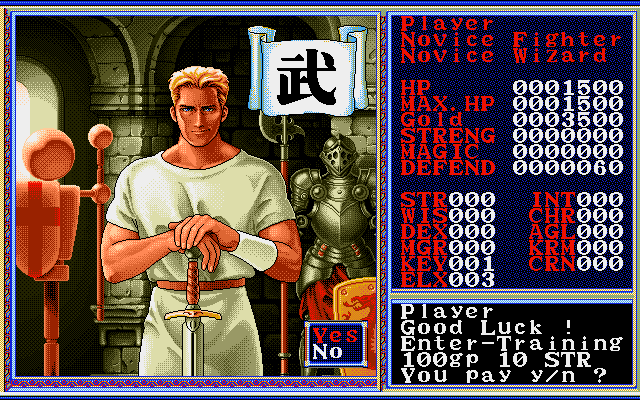
If you do things that way, then the problems start at the compositional stage. You have no choice but to prioritize the first three FM channels and the PSG, and that cripples the entire piece. For example, say you've come up with some sick-ass arpeggios to fill out the sound. Well, those are going on the PSG channels for sure, even if they would sound better played on an FM piano or something. Drums? Again, you have to waste one of the first three FM channels, and that channel could've been used for a melody while the OPNA's dedicated ADPCM-B channel plays good drum samples, perhaps aided by the chip's internal ADPCM-A samples... and so on. It's a shame, it's a goddamned shame. Hiroaki Sano was smart when he composed the music for Mime: he ignored the OPNA entirely and made two versions of the OST: one for OPN, and the other for MIDI modules like the Roland SC-55. And even though the MIDI arrangements are infinitely lusher and more complex, the charm of FM synthesis and square waves wins for me every time.
Do keep in mind most of this is just my reasoning, so take it with a grain of salt. If you disagree, feel free to do your own research and come to your own conclusions.

Well, that was a mouthful. Fortunately, I don't have to deal with any of that compatibility bullshit: all Mega Drive consoles have pretty much the exact same soundchips, so I can plan around its full capabilities (or at least what *I'm* capable of doing with it) to make Egarer sound a lot better. Let's get on with it!
Because this piece uses an acoustic bass, using extended channel 3 with algorithm 4 was a no-brainer. I'm also using PCM drums here, so the layout looks like this: FM 1 is for the main melody and FM 2 for detuned echoes. FM 3 is split: operators 1 and 2 take turns doing the arpeggios on a simple 2OP piano as well as more detuned echoes in some sections, and in others I fill them with some simple 2OP strings. Meanwhile, operators 3 and 4 are for the acoustic bass. Channels FM 4 and 5 are used for the piano chords, for which I'm using several modified versions of the electric piano from YU-NO to reduce shrillness at higher notes. Channel FM 6 is obviously for the PCM drums, and I only used three samples: kick, kick + crash and snare. The snare is from a Saitama Saisyu Heiki song (it debuted on The Cold Shade of Night) and the others are from the Arachno Soundfont. As for the PSG, the square waves are used for echoes and backup. Sometimes I'll have the second channel play the root notes with a bit of vibrato to fill out the sound better. The noise channel is for hihats.

I've used a surprisingly large number of FM instruments in this piece. In addition to the acoustic bass and pianos I discussed previously, we have several versions of my custom Orwell Strings, a modified Sakimoto choir from Master of Monsters (how many times have I typed that already?) and a further modified (again) version of my trumpet synth--at this point it's comical I'm still calling it that. The "synth & crystal" instrument makes a return (I hadn't used it since Legendary Wings, I think), and those are all the instruments I've used for the lead melodies. They all have much more complex timbres than what was used in the original version of Egarer, so the sound is much richer overall. This was also my first time using a software vibrato effect on the echo track. Never thought to do that, but I saw it in a MezzoForte .fur and decided to try it out--sure enough, it works very well.

Phew, I think that's pretty much it. It's a cover, so other than making the drum patterns just slightly more complex, I barely made any real changes to the structure. It's curious to think that while the Mega Drive's YM2612 + SN76489 combo is definitely inferior to the OPNA chip overall, depending on your approach the result can be night and day, and the YM2612 can stand up to its older, more powerful brother with its head held high.
See you around.
Back to the index