for YM2612 + SN76489
by MetallicOrwell
Well, we're back at the metal forge. This is my big original piece for the month of June, and it sure took a while to get done. I'm an admirer of In Flames' early work (up until Clayman), so the idea of doing something in the vein of those early albums is something I'd been considering for some time. No other band scratches quite the same itch, because it's very specific: twin guitar overdose, downtuned riffs, growled vocals, songs that are mostly mid-tempo with just the right balance between predictability and experimentation. It's like if power and death metal had a baby with just the right amount of each, though that obviously changed as time went on. By Whoracle they had dropped the death metal elements almost completely, and Colony is basically just power metal with growls and downtuned guitars. Not complaining, by the way: I love that album so much that two of the songs included in it (Zombie Inc. and The New Word) are the ones that inspired "Twin Flames" here. The reason I chose that title should be fairly obvious: twin leads + in flames = twin flames. For the record, it has nothing to do with the new age concept of the same name. Anyhow, let's get to the rundown.

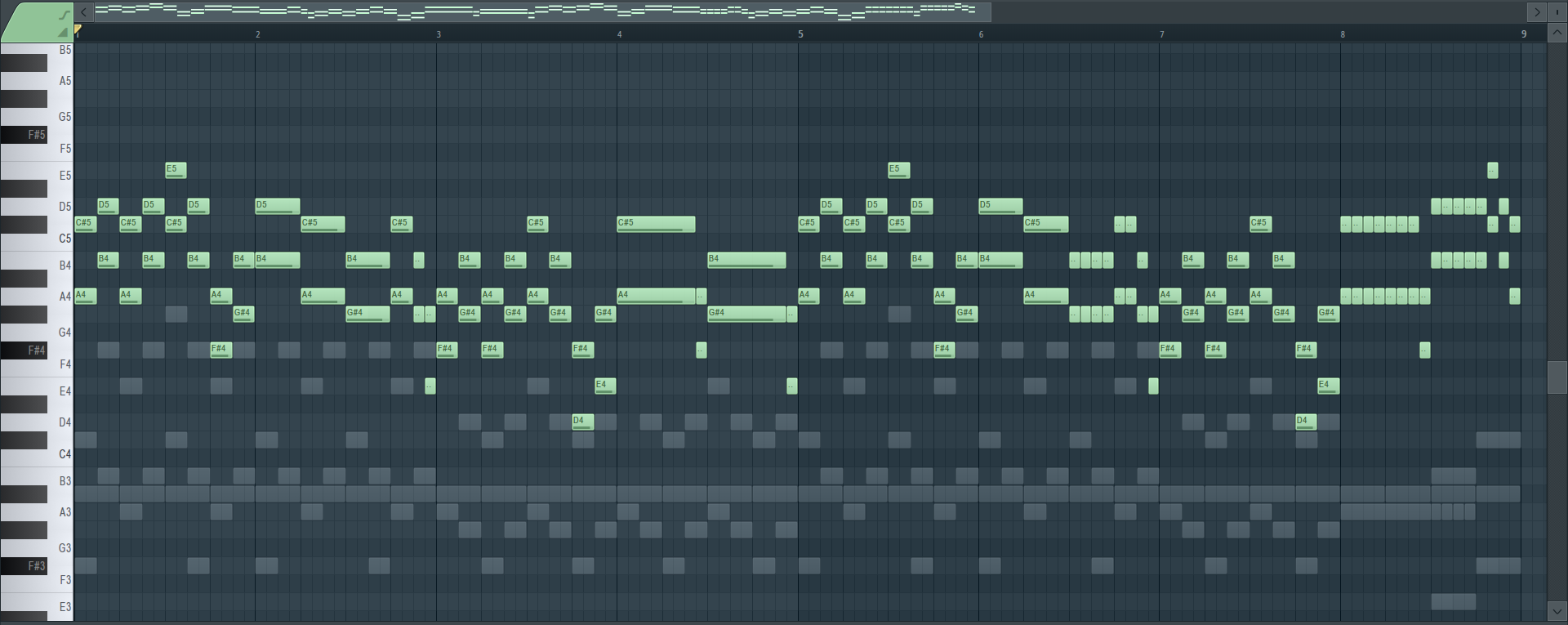
Composing this was quite different from The Metallic Maiden: instead of an unexpected pivot leading into an uncontrolled frenzy, I had a plan and stuck to it pretty closely. I wanted this piece to be similar to Zombie Inc., except that after the mellow break, there'd be a fast part inspired by the instrumental section from The New Word, and that's pretty much what you get here (with my own DNA injected into it, of course). I had originally planned this piece to be in E minor throughout, and the Zombie Inc. inspired intro does start in that key. But then I changed it to F# minor in the part where the half-time drums kick in, and I got stuck for the rest of the song. I couldn't figure out how to go back to E minor, but given that the result is pretty good anyway, I'd say it was a happy accident.
Composing the main part was an interesting experience, because it exposed what I like to call my "composing vices". For example: reusing the intro melody for the chorus, having the verse start without the melody at first to let the song breathe, reusing said verse after the chorus for a guitar solo... not to mention the pre-chorus sounds pretty similar to that of The Metallic Maiden. I did try to do interesting things with the drum beat and the bass to prevent it from sounding too basic and similar to my previous pieces, and I think I succeeded for the most part.
This is a bit of a tangent, but I think I'm starting to understand why pop structures (ABABCB and variants) are so popular in music. It's not just because it makes the song predictable and easy to enjoy for the audience, it's also because it makes the composer's job so much easier too. It's the most widespread way of composing music because our brains are wired for it, and when I was composing Twin Flames, my instinct naturally gravitated towards it--I had to consciously steer away from it to keep the song interesting, and I have to wonder how much of that is because of how new I am to making music. That probably made little sense, so I'll try to explain (to myself, as well). Because this song was inspired by old-school In Flames, I listened to those albums a lot while making this, and I noticed one thing. The really early stuff tends to be more experimental: Lunar Strain (1994) barely uses pop structures, and it includes weird things, like strings, female vocals, lots of changes in the drumming and time signatures, etc. The songs from Subterranean (1995) are also quite labyrinthic and difficult to enjoy at first--you have to figure them out before you can really appreciate them. When you compare that to something like Colony (1999), you see the difference: the band seems much more comfortable pumping out a bunch of tunes that are easier to digest, and which were probably easier to compose, as well. They do little things here and there to differentiate the songs and make each of them a bit more special, but it's far less ambitious. So, the overall trajectory is: as time went on, the music became simpler.

A case where the opposite happened that I can think of is Metallica: the songs from ...and Justice for All are far more complex than the ones from Kill 'em All. I remember reading an interview from 1991 where Kirk Hammet remarked that the songs from Justice were so long that, when they'd play them live, he would see the people in the first row yawning (or something like that). When I first read that interview years ago I thought: no, jackass, the problem isn't that the songs are long, it's that they're bloated. It'd be one thing if the nearly 10-minute-long title track had enough musical content to justify its length, but it doesn't. It still uses a predictable pop structure, and the chorus is way too long. Disposable Heroes is another similar offender that I can think of off the top of my head. There are other thrash metal bands, like Vio-Lence, who are capable of packing more riffs and interesting stuff in a 6-minute-song than Metallica can in a far longer one. I used to think this was just their limit as musicians, but now that I also make music, I'm starting to see things differently. It's not easy to fight your instincts--sometimes a song just feels like it works as it is and doesn't need any more stuff in it. But if that were the case, expansions wouldn't work, and yet they do: take the original version of Venus Fire from Thunder Force III, which is only a minute and a half long; it's great as it is. Then Saitama Saisyu Heiki expands it into a 6-minute-long monster that works a million times better: as it turns out, there was so much more potential in Venus Fire than Yamanishi was able to realize in 1990.

I'm rambling now. I'm trying to explain all this stuff to myself so I can understand it. Can any piece of music be made 10 times longer effectively? Is it just a skill issue if you can't figure out how to do it? Will my trajectory as a musician be similar to that of In Flames or Metallica? What will I think of all this a year from now? Why is the sky blue? Seriously, why?
I do believe it's time to get back on track, Jesus fucking Christ. Anyway, after the second chorus I decided to attempt the whole acoustic interlude thing that is so common to the melodeath genre. First you get the rhythm section as the electric guitars fade, then the bass guitar and lead melody come in, then you get the drums, and after that we go back to metal. When I first came up with the acoustic riff, there was some time signature fuckery going on. It didn't quite fit in a 4/4 grid, so I set some sections to 7/8 to make it make sense. The problem was that I couldn't figure out how to make the drums work, so eventually I added a couple of extra notes to make it all pure 4/4. There, problem solved and headache gone. Incidentally, I dared to use rimshots in this section (inspired by Dark Tranquillity's masterpiece, Punish My Heaven). I was worried they might sound a little too wimpy, but I think they fit.

This is where the part of Twin Flames that was inspired by Zombie Inc. ends--we now instead take inspiration from The New Word and its excellent bridge. I really do think it's one of In Flames' best moments because of how varied the guitar work is, and I knew it would function as a perfect finale to my piece. So, I reused the pre-chorus with some variation to transition from the acoustic interlude to the final part. I laid down some chord progressions to use as a base so I could come up with a solo, and then studied some S.S.H. midis in order to get some ideas on how to write fitting riffs. The problem was that this section ended up sounding exactly like an S.S.H. power metal song, complete with a key change (once again, instincts), which wasn't what I was going for and didn't fit the whole idea for Twin Flames. So, I had to delete this part and start from scratch. I was able to salvage the guitar solo, though, by relocating it to a previous verse before the acoustic break. Another good thing that came of this was that I learned how to better sequence palm-muted riffs. Usually I'll have two channels for the rhythm guitar, the second playing perfect fifths to the first. But during the palm-muted parts, if you make the notes shorter and transpose the fifth one octave lower (so instead it becomes a fourth), it sounds heavier, especially if you do it in short bursts and combine it with power chords. Another lesson learned from Senpai.
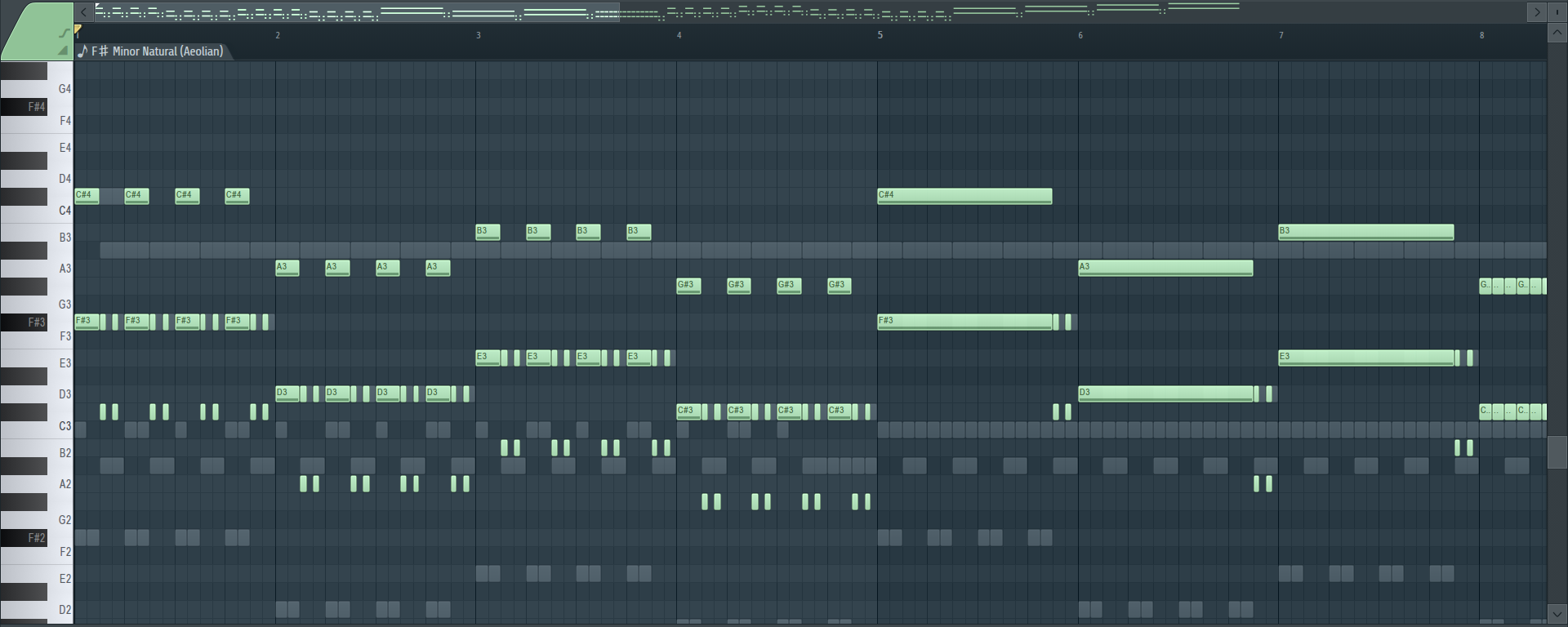
Again, I had to redo this part, so I looked at a Guitar Pro transcript of The New Word to get ideas. I did things the other way around, by coming up with the melody first, chopping the notes, and then adding the chord progression and the riffs. I combined palm-muted riffs with a simpler kick + snare drum pattern, and then rapid-fire kicks with open power chords. I think the contrast works fairly well. As for the leads, there are a lot of arpeggios in this section, and those were pretty fun and easy to do. There's one particular part where they continue playing while the entire rhythm section does accented hits, and it's probably my favorite part of the piece. Then there's a callback, and it ends.
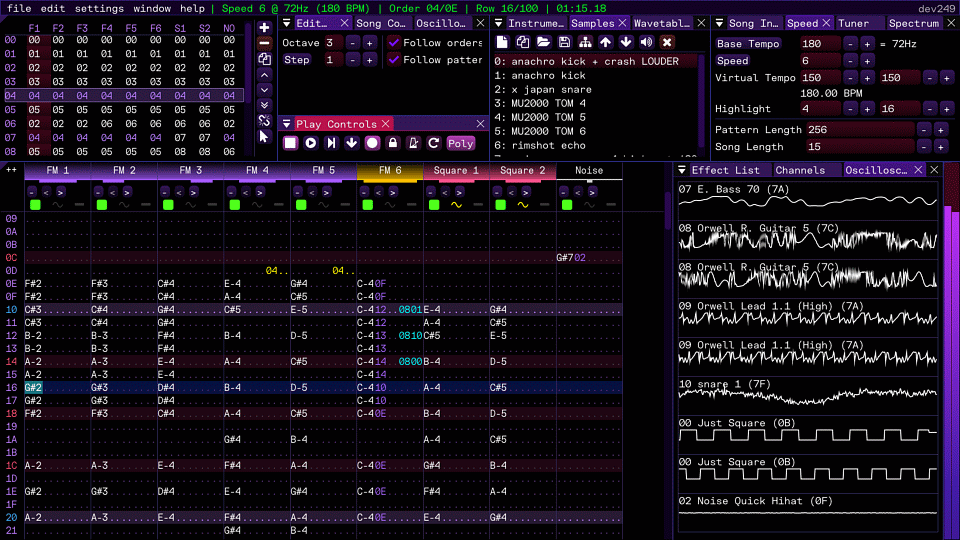
And so ended the process of composing the MIDI sketch on FL Studio, but adapting it to the Mega Drive on Furnace was a whole 'nother can of worms, although with a surprisingly simple solution. The problem was that some of the twin leads in the sketch went quite low into the 3rd octave, and none of my lead guitar FM patches sound good in that range. Lots of frustration ensued, with me tweaking patches until 2 AM. No matter what I did, I could not get the sound I wanted: sometimes the timbre was almost perfect, but there was just a little too much distortion and it was sounding muddy. I like my lead guitars to sound clean, so that they don't get muddied up with the rhythm section. I knew the solution was to simply transpose the problematic sections one octave up, and eventually I gave up and did just that. I don't usually compromise, but this time I did. So, I just used my Orwell Lead 1.1 (I think it debuted on Battery) as well as a slightly modified version of it for the lead guitar. I added some pitch slides, vibrato, the works.
The rest of the instruments? Same as usual for the most part: E. Bass 70 (Chunky) and my custom Orwell Rhythm Guitar V5, as well as a softer bass and acoustic guitar patches for the mellow section. The drums are a mishmash: toms from the Yamaha MU 2000 EX power kit, kick from the Arachno Soundfont, snare from X Japan's Art of Life, and the rimshot I extracted from one of FLEX's drum kits. I baked some echo into the actual sample and pitched it down a little, too, to prevent wimpiness. And of course this song uses my metal formula: FM 1 for bass, FM 2 and 3 for rhythm guitars, FM 4 and 5 for leads, FM 6 for PCM drums and occasional echo, square waves for support (mostly echo) and noise for hi-hats and crash cymbal support. There are also composite samples to prevent snare drum tail cutoff during rapid-fire kick drum blasts, etcetera.
And that's Twin Flames by your boy MetallicOrwell. I definitely didn't hold back on the twin leads, even though maybe I should have. Because the music I make is always instrumental, I have a tendency to always include a lead and rhythm section, out of a sense that otherwise some sections would feel too empty. But if you listen to the instrumentals In Flames made back in the day, like Man Made God (the greatest piece they ever composed), the lovely Wayfaerer (now there's another masterpiece to take inspiration from) or Dialogue With The Stars, the leads are a little sparser. They do let the rhythm section breathe a lot more than I did here, don't they? In fact I'm listening to Wayfaerer right now, and those keyboard solos are giving me ideas. Not to mention the change from minor to major and back, and those time signature changes... so many possibilities for future pieces.
See you around.
Back to the index