Rusty ~ Queen in the Dark Night
for YM2612 + SN76489
by MetallicOrwell
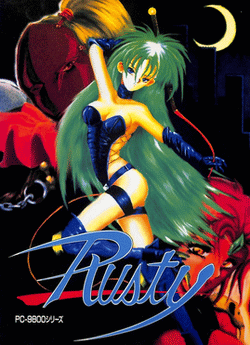
After releasing what I believe to be a pretty good original song, it's time to go back to covers for a little bit. Like any OPN scholar worth his salt, I've had my eye on Rusty for a while, because its OST is one of the most popular on the PC-88/98 system. However, reducing the discourse around Rusty to only its music (as good as it is) would be a disservice to the game as a whole, because it's pretty fascinating all around. Rusty is a gothic action-adventure game, very much inspired by Castlevania in just about every respect, except that Simon Belmont (who was usually depicted as a Conan the Barbarian look-alike back then) has been replaced by a hot chick in bondage gear. Now that gives whipping enemies a whole new meaning, doesn't it? Hmm. Anyhow, it obviously draws very heavily from the popular Castlevania games, but also from the original Vampire Killer for the MSX2, since the stages go all over the place. You have to find keys to progress, there's a great variety of environments and enemies, and perhaps most shockingly, it plays quite well considering it runs on hardware that is absolutely not well-suited to platform games. The color limitations definitely hurt the presentation, but they don't ruin it. As for the music, we'll get to that soon enough.
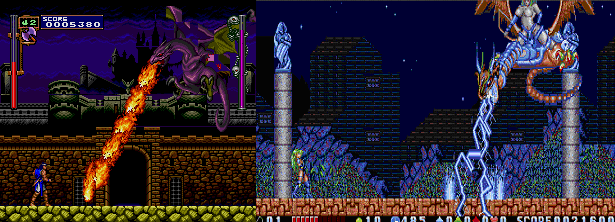
No write-up about Rusty would be complete without mentioning its striking similarities to Castlevania: Rondo of Blood. The games were released roughly three-and-a-half months apart (Rusty being first), and they share very specific elements, like rescuing maidens, the anime aesthetic (which was a new thing for Castlevania), several bosses, etc. People speculate about the possibility of Rondo of Blood being influenced by this humble Castlevania clone, and there are even some theories of how the teams for both games might have been in contact, or maybe Rusty was an abandoned Castlevania project. I'm going to try to make sense of this mess, but keep in mind these are just my deductions after doing some research--there's a good chance I got some things wrong. I'm also aware this has nothing to do with my cover, but it's fun, so I'm doing it anyway. How often does a chiptune artist get to feel like Phoenix Wright gathering evidence for a case?

Rondo of Blood first appeared on Japanese magazines in July of 1993, the same month that Rusty was released. First of all, the character designs look quite different from the final ones, and there are no screenshots of the anime cutscenes whatsoever. They do mention "animation and voices", and they explicitly state that you get to see "visual scenes" when you save each of the maidens; the staff were also already arguing over which actor would suit each character best. I think the cutscenes were in the early stages here, if at all--some rough sketches, etc; otherwise they would've shown them off for sure. Now, it's not at all difficult for me to imagine that the studio responsible for the Castlevania series would be aware of Rusty; the devs were no doubt avid gamers and probably had a PC-98 or two at home (or at the office). Word of Rusty being a cool Castlevania clone got around, some guy bought a copy and brought it to the studio, and then the devs played it and were inspired by the art style and cutscenes. Does it seem farfetched--maybe even insulting--to think they'd let a lowly rip-off for a porn-ridden system influence the direction of the next installment of the prestigious Castlevania series? No, I don't think so. I believe it's quite plausible that Rusty's style and cutscenes influenced Rondo of Blood's. Also, let's be real here: there's a good chance some of those devs were big fans of stuff like Dōkyūsei, especially when pent up. No one's an angel. Of course, the PC Engine CD was known for the whole anime aesthetic, so they could've decided to go in that direction regardless, but the timing is a little suspicious.

Next point: there are a few Rondo bosses which seem to be inspired by Rusty ones, and the most damning examples do not appear in those early screenshots either. Quite interesting, no? Again, they could've played through the game and decided to copy some of them; there's nothing that would contradict that theory, as far as I can tell. Most of the other similarities, however, can be explained simply by pointing to the shared pool of video game and gothic tropes which both Rondo and Rusty draw from, as well as material from previous Castlevania games. The first level being a ruined town was done first in Castlevania III, for example, as well as the second level being a dark forest (that was in IV), and so on. The thing about rescuing maidens seems a little uncanny until you realize it's not really the same thing; in Rondo they are optional, whereas in Rusty they are not. It's actually much more similar to how in Castlevania III defeating some bosses frees a character that was trapped or being controlled, like Grant or Sypha (although obviously no one joins bondage chick in her quest). In conclusion, my opinion is that yes, it's very likely that Rusty influenced Rondo's art style, cutscenes and bosses to some extent. Game development was smaller and faster back then, so from July to October there was plenty of time to implement lots of new things.
Now, I think that was enough--it's time to talk about Rusty's music. It's excellent all around, and it contains the kind of pieces you'd expect in a Castlevania-inspired game: from fast and energetic to creepy and moody, and very catchy all around--definitely every bit as good as any Castlevania OST from the time period. Some of the songs sound like the kind of baroque (I think) stuff you'd hear in Bloodlines, whereas others are more straightforward video game-y fare. Queen in the Dark Night is the first stage theme, the most famous piece of music from Rusty, and the one I decided to cover here. Believe it or not, my original idea was to mash it up with Fillmore from Actraiser, and alternate between sections from each of the two songs to form one big, cohesive piece. That would've been absolutely sick if it had worked, but it didn't because of the difference in time signatures. Fillmore is in regular-ass 4/4, whereas Queen in the Dark Night is almost entirely in 6/8. This makes it impossible to mix and match sections without altering them to the point where they become unrecognizable, which defeats the whole point. Ah well, I can cover Fillmore at a later time to make up for that. Let's focus on Rusty for now.
There are OPN, OPNA and OPL2 versions of Rusty's music. I've ranted before about how the need to maintain backwards compatibility crippled a lot of PC-98 OPNA music, so I won't go into detail again here, but suffice to say that all the things I said about the Revival Xanadu OST apply here. So much so, in fact, that the OPL2 version of Queen in the Dark Night doesn't even sound like much of a downgrade to me, even though the chips are on completely different leagues. It all comes down to two things: they could use the full potential of the OPL2 (mostly), and the FM patches used on the OPN/OPNA versions are not that great. So, what happens 30+ years later when some chiptune nerd decides to adapt the song for the Mega Drive, and uses its YM2612 + SN76489 combo (which is objectively inferior to the OPNA) to the fullest? You get something that, frankly, completely blows the original versions out of the water. John Tay already did a cover of this song a few years ago, and it sounds fantastic with that Battle Mania Daiginjou Rhythm guitar; not to mention the slight liberties taken with the melodies give the cover a nice little bit of spice. However, I wanted to do my own thing here. Let's nerd out some more.

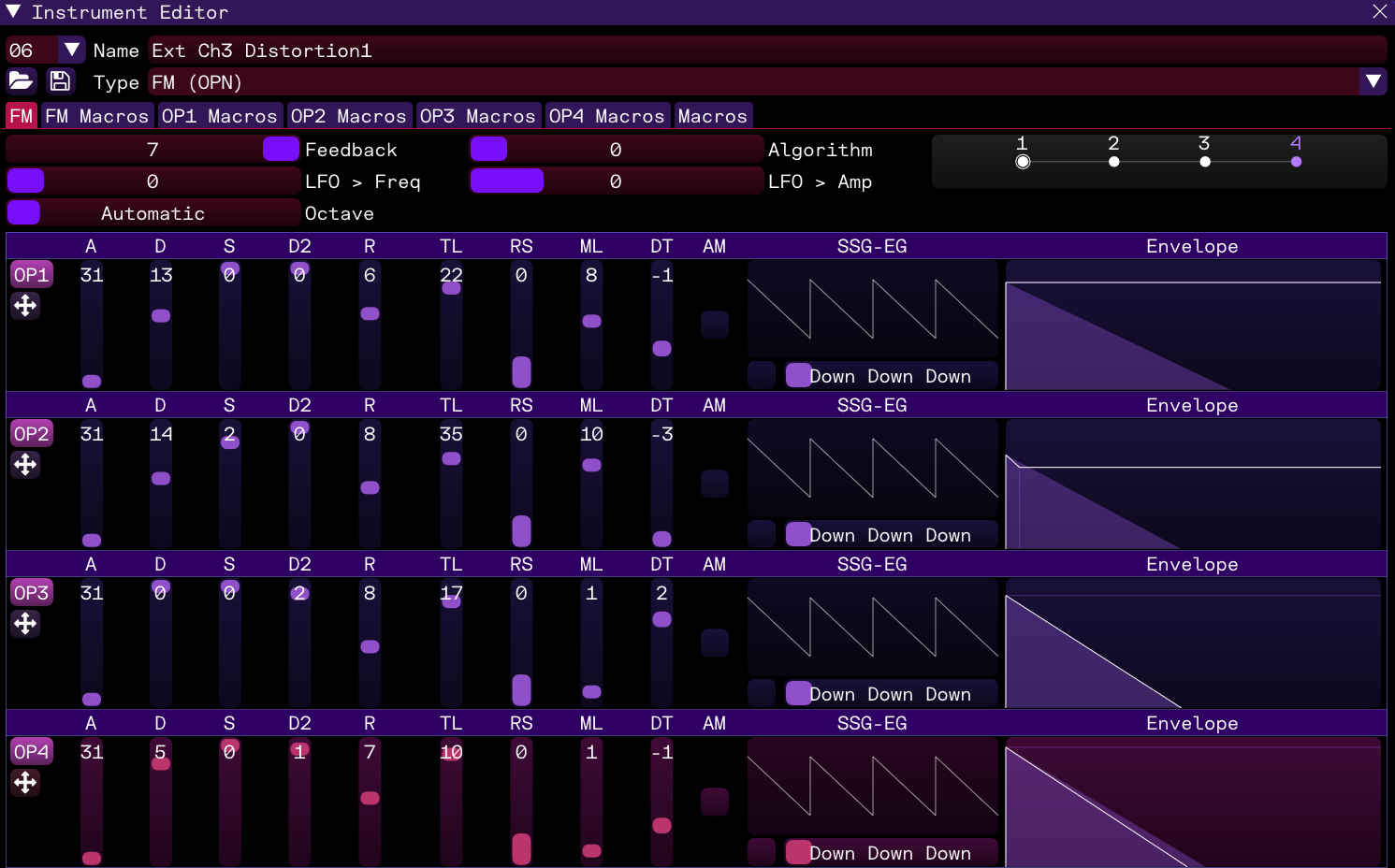
I based this on the project file for The Cold Shade of Night, so the sound design is basically the same. Nothing wrong with phoning it in from time to time, right? I didn't want to give Queen in the Dark Night my usual metal treatment; I wanted it to sound energetic but also moody, and the template I came up with for TCSON accomplishes that nicely. There's bass, guitar, chords, melody and counterpoint, which is just about everything you can fit into the limited polyphony of these systems, and it also shows how good a composer Kenichi Arakawa is. In the rhythm section, we have a modified version of the bass from Green Hill Zone (Sonic 1), as well as Molkirill's magic rhythm guitar, which can play a note and its fifth at the same time if you use it on extended channel 3. When I first tried it months ago I couldn't believe it was possible, because it doesn't use algorithm 4, but this time I decided to try doing the same thing using my own Orwell R. Guitar (which wasn't designed to be able to do that), and with a little modification, it works exactly the same. I think Molkirill was just messing around, using different patches on channel 3 to see if they worked somehow, without fully understanding the mechanics of it. I sure as hell don't, because old-school FM synthesis is a rabbit hole deeper than the Kola Superdeep Borehole.
Chords are very useful in thickening a piece's sound and mood, but I could only afford two-note chords with the Mega Drive's limited polyphony. They're located in channels FM 4 and FM 5, panned to each side, and played on my custom string ensemble. In some sections I actually use a brass section patch, though, for increased intensity. The melody, located on channel FM 1, cycles through a variety of instruments, mostly synth leads, but also a pipe organ and lead guitar. There is one particular section where I use my own rhythm guitar, and also a combination of the Sonic 1 Ring instrument and one of Molkirill's bell patches. Modified orchestra hits from Sunsoft's Batman also make an appearance. The SN76489's square wave channels are used mainly to counterpoint the main melody (just like in the original OPN and OPNA versions), but they also handle other various forms of accompaniment. As for the drums, we have kick and kick + crash samples from the Arachno Soundfont, the same S.S.H. snare I used in The Cold Shade of night, and three toms from the Yamaha MU-2000, as well as the SN's noise channel for hi-hats, of course.

Queen in the Dark Night is a fantastic piece, and I do think I've done it justice here, because it sounds much more potent than any of the original versions. The bass and guitar give it a deep and aggressive low end, the chords cover the mid-range, and the melodies hover comfortably in the upper frequencies, while the drum samples are potent and clear enough to cut through the mix perfectly. Basically, this thing sounds brilliant. I didn't think I'd have enough to say about Rusty to get close to 2k words, but I am long-winded. If you've made it this far, you're a trooper.
See you around.
Back to the index