for YM2612 + SN76489
by MetallicOrwell
I hadn't covered music not related to video games in a while! The last time I arranged a song by a metal band was way back in October of last year--it's been a lonely, lonely time. I suppose you could consider Demetori a band, but they're more like a studio project, and again, they base everything they do on Touhou music. Metallica, on the other hand, is *the* metal band, bar none. I'm not necessarily saying they're the greatest, but they're definitely the most popular ever, as well as one of the most influential. I'm a Metallica enjoyer for the most part, and I've toyed with the idea of adapting their music to chiptune before. The thing that was stopping me is that nearly all their songs have a traditional pop structure for the most part and just generally feature a lot of repetition, so I thought they wouldn't translate well to a musical style that lacks lyrics. Well, I've proven myself wrong, because I think Battery here has turned out quite excellent.
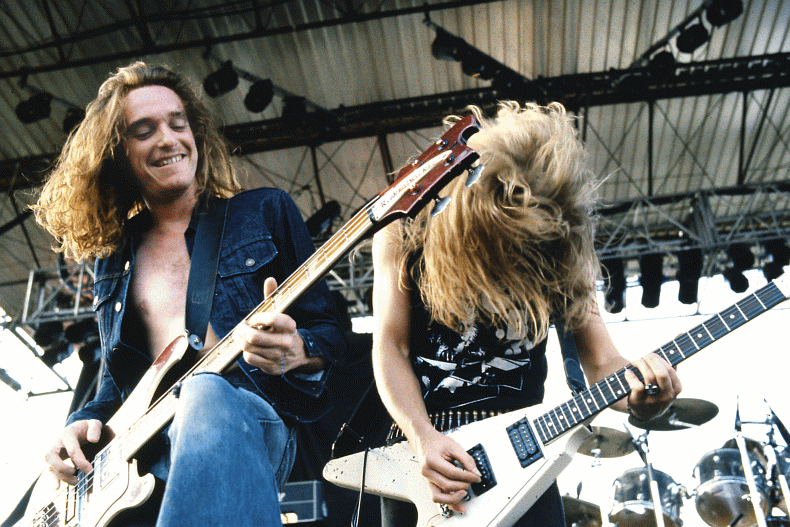
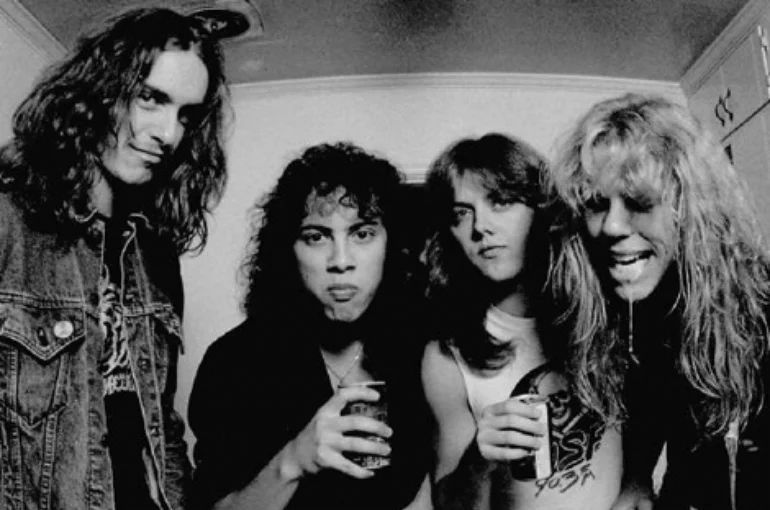
So much ink (and blood) has been spilled over Metallica in the past four plus decades, and I'm not going to get into any of the drama in this write-up. I've said before you can only appreciate a piece of music once you've taken it apart and built it back up with your own hands, and I definitely have an appreciation for Battery now that I didn't have before. It's always been one of my favorite Metallica songs, but I always thought it was kind of simple--and it is based mostly around a single riff. However, there are quite a few variations of said riff with different endings, and they are incorporated into the verses and choruses in really rather unorthodox ways, I'd think. Obviously, Battery isn't a Dream Theater song or anything, but it is more than I'd given it credit for all these years, and it shows Metallica's growth as musicians during this era. They were taking basic thrash metal, which is street music, and making it more complex and ambitious. Orion makes that point perfectly, but even the introductory song, which is meant to make you bang your head until you kill yourself, has nuances and lots of nice touches.
This isn't really an arrangement in any meaningful sense--it's a straight-up cover, and given that thrash metal came before the melodic death metal bands I've covered / arranged in the past and is generally a simpler genre, you'd think this would be a step backwards for me. However, it has actually allowed me to try out some new things and refine existing techniques. Time for the rundown.
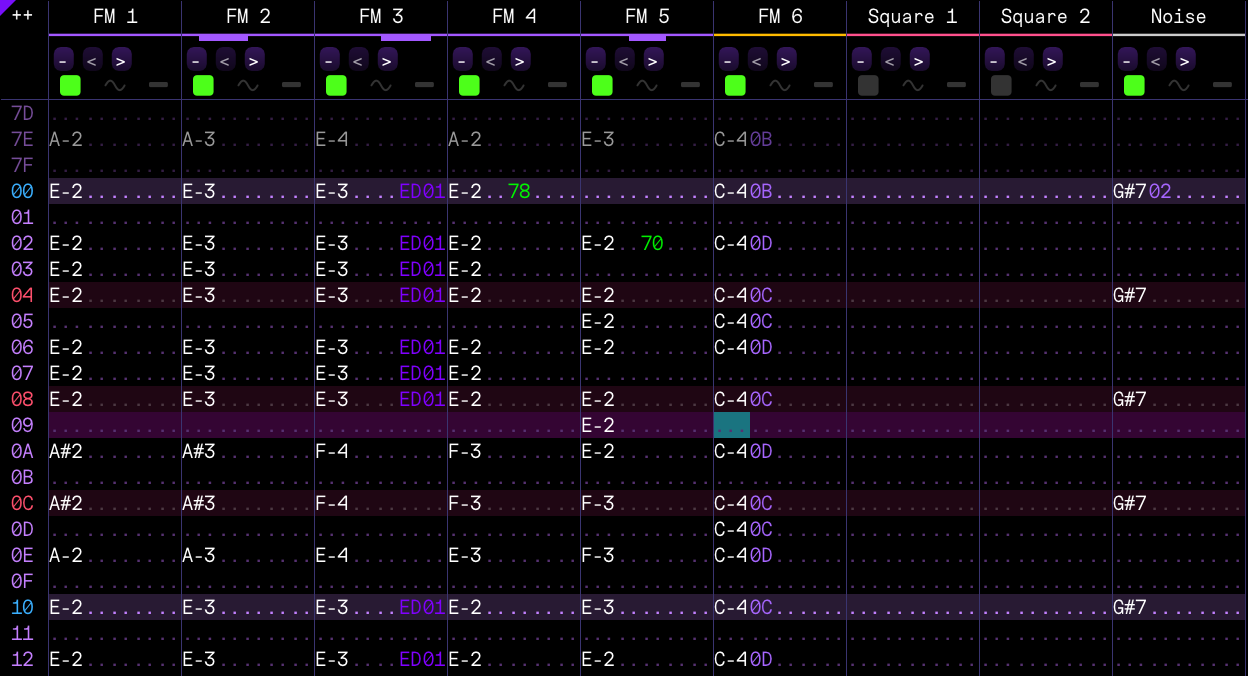
Firstly, there is the acoustic guitar at the beginning, for which I modified a "steel guitar" patch included with Furnace to make it sound warmer and decay more slowly. Getting it to sound anything like it does on the album was challenging, because James uses some arpeggios. I had to double the tempo for finer control, as well as experiment with retrigger, note delay, and out-of-tune echo to mimic the rich sounds of the real thing, and the result isn't too bad. They keep layering harmonies, and then the metal part comes in. For this section, I'm using my standard metal formula: bass on FM 1, two rhythm guitars panned to the side on FM 2 and FM 3, harmonized lead guitar melodies on FM 4 and FM 5, FM 6 for PCM drums, and the square waves for support. The first channel is harmonized with the FM guitars, and the second one is doing the out-of-tune echo of the first. This is definitely a recurring theme.
When the song proper begins, I switch things up a bit. Battery is all about the main riff, the rhythm guitar. Now, when I did Metal Squad, I experimented with three rhythm guitar tracks in some sections where I could get away with it. But what if I could get away with it throughout most of Battery? What if in some specific parts, *four* rhythm guitars could fit? That would make it sound massively heavy, wouldn't it? There aren't really any harmonies after the intro, and I could use the square waves to do the echo of the lead guitar.
Well, that's what I did. And it worked--the sound is so thick and heavy that it almost rivals the original studio recording of the song. Let's autopsy this thing track by track.
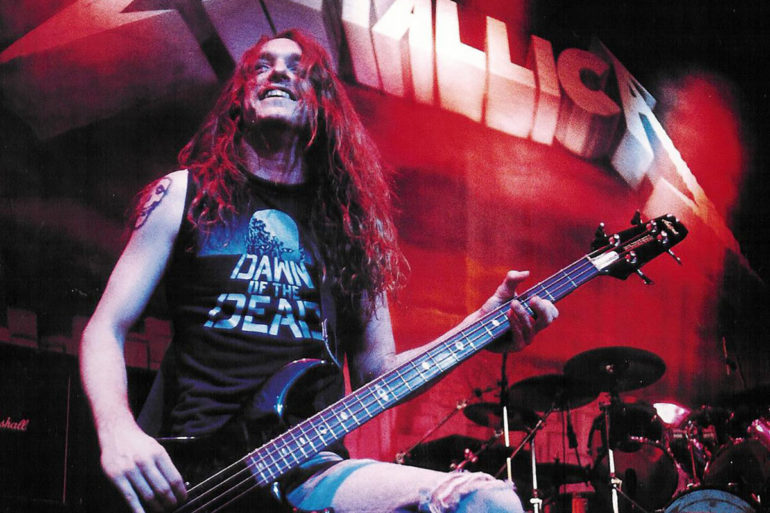
First off, the bass! It's the E. Bass 70 preset, nicknamed "Chunky" by me because I'm brilliant like that. So was Cliff Burton, but the way he played his bass is very different. He used his hands, and his playing on Battery has often been described as somewhat messy, as he doesn't even attempt to keep up with James' downpicking. He does include flourishes here and there, and I've used those. For the most part, however, the bass in my cover actually sounds more like the way Jason Newsted played in Metallica, especially in ...And Justice for All: with a pick, very precisely, following each note of the guitar without missing a beat. Not that you'd know because of the shitty production, but you can find isolated bass tracks for some songs (real ones, included in Guitar Hero). So yeah, the bass is mostly Jason-style throughout. Sorry, Cliff.
As for the guitar, I've discussed the two rhythm tracks (my custom Orwell R. Guitar) panned to each side, but there's a third one in the center. That uses one of the synth-y instruments that make up the guitar from the intro to Thunder Force IV--let's call it the "TF4 synth". And then, as if that wasn't enough heaviness, there's a fourth track doing out-of-tune echo in some parts. Yes, I have a bit of a love affair with the rhythm guitar, and I take it out to dinner and buy it flowers and whatnot. Lead instruments? Mostly my Orwell Lead guitar, although I did make a new version which sounds a bit more distorted. As for the vocals, I was surprised to discover the TF4 synth works quite well for that too, especially when backed up by square waves.
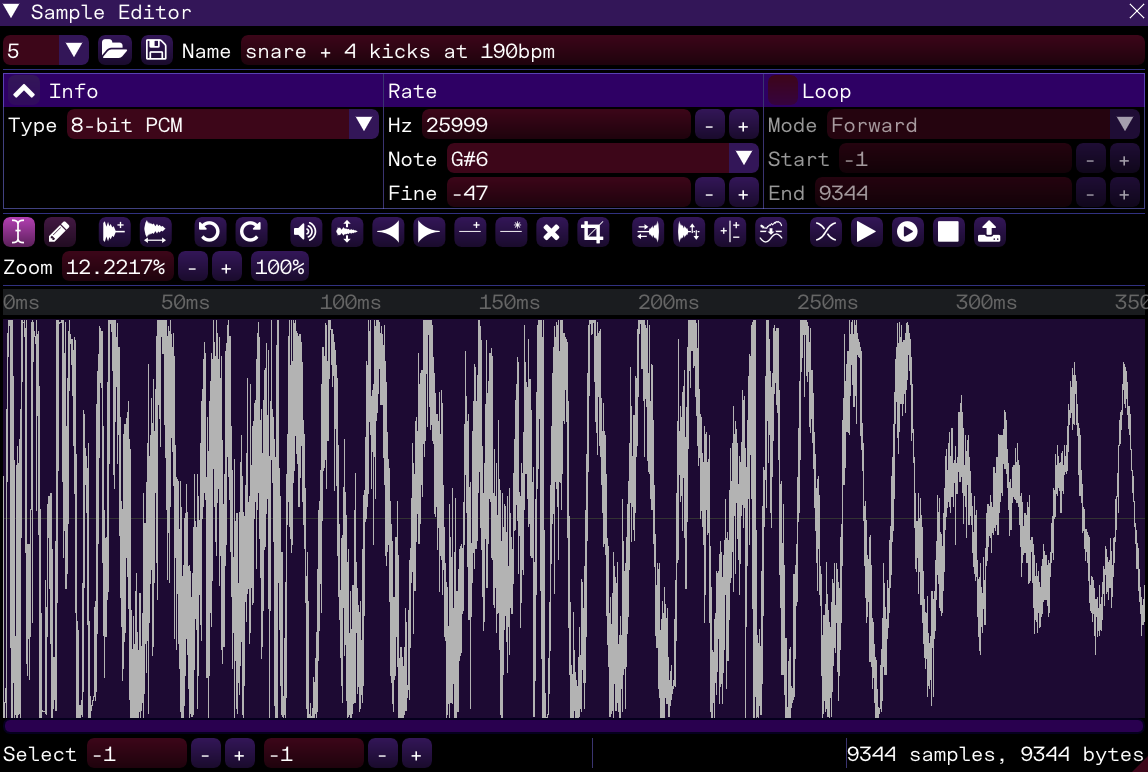
The drums? Arachno Soundfont power kit, as always. They fit this song especially well, because they sound similar to Lars' kit in the studio version. The patterns are reasonably faithful to the original, though I did change some of his more questionable fills. Authenticity is important, but so is good drumming. In total, and somewhat surprisingly, this song uses fewer samples for drums than my typical metal stuff--only six. Kick, Snare, Kick + Crash, two toms, and "snare + 4 kicks at 190bpm" for some sections. I still can't get over how deranged that last one sounds.
Now, every Metallica enjoyer out there knows that you could point a gun at Kirk's face and he still wouldn't take his foot off the goddamn wah-wah pedal. So, when it's time for the solo, how do you mimic that sound on the YM2612? Uhh... you do what you can. Lots of pitch slides and vibrato are a good start, but I also use my own modified version of the Time Trax guitar by Tim Follin (not the Savaged Regime version) in some sections of it for extra grit, as my custom Orwell Lead sounds very clean. In general, it's the shakiest part of this whole cover, but I think it's good enough.
I thought of adding more flourish and effects to James' vocal lines, but it wasn't really necessary for the most part. I think I now have a firm grasp on how to construct vocal melodies for a chiptune version of a metal song: you take notes from the guitars (even if they're not the notes the singer is actually hitting) and keep it fairly simple. This way, it sounds coherent and consonant.
Overall, this is quite a headbanging-inducing piece of metal madness. The part with the double kick drumming might be the heaviest moment yet in any of my pieces, and that's saying something, because I've covered more extreme subgenres of metal before. It's all about the production: my approach to the almighty rhythm guitar is much more evolved than half a year ago, and it bloody well shows.
How to end this write-up? Oh, I know exactly how:
See you around.
Back to the index