Musha Aleste ~ Fullmetal Fighter
for YM2612 + SN76489
by MetallicOrwell
If you thought my Fire Field arrangement from November was fast as balls, then get your butthole ready, because I'm going in dry at 294bpm.
Making completely original music isn't the only way to flex your compositional muscles. If there's one thing I've learned from Saitama Saisyu Heiki, Naoto Shibata, MaestroDraven and many others is that you can take an existing piece of music and expand upon it much further. After doing so much S.S.H. stuff in particular, I've picked up on a formula which he used often to great effect: keep it faithful in the first part, add your own flavor in the second, and then finish it off by repeating the chorus in a higher key. For a fledgling musician like myself, it seemed like a good way to test my newly discovered compositional skills in a fresh, exciting way.

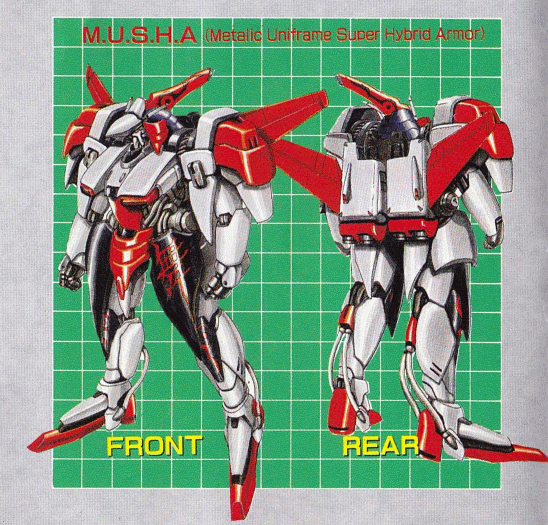
So that's what I've done here: I've taken Fullmetal Fighter, the first level theme from Musha Aleste (already a fast, energetic metal song) and pushed it so far beyond its original level of intensity that the result honestly blurs the line between coherent, enjoyable music and just total madness--because of course I did. This is simply the effect that metal music has on me. Sometimes, a piece of music *wants* you to go as hard as possible on it.
I based this on a MIDI by one "tom kim". If you haven't heard of him, it might be because I downloaded it from an obscure Japanese webpage from the early 2000s (there's a bit of a pattern here, huh?). My reasoning was that this would simplify the compositional process: the MIDI file in question is pretty spot-on to begin with, so I could import it into FL Studio and modify it to my heart's content. Like I said, I kept the first minute intact, but after that I got to work. Taking inspiration from S.S.H., I made the riffs far more complex, and also deleted the original melodies / solos and instead composed my own. I really can't say enough good things about FL Studio's piano roll--its "lock to scale" function is a godsend that makes the process of coming up with melodies incredibly fun, and for a fledgling musician like myself, it's catnip.
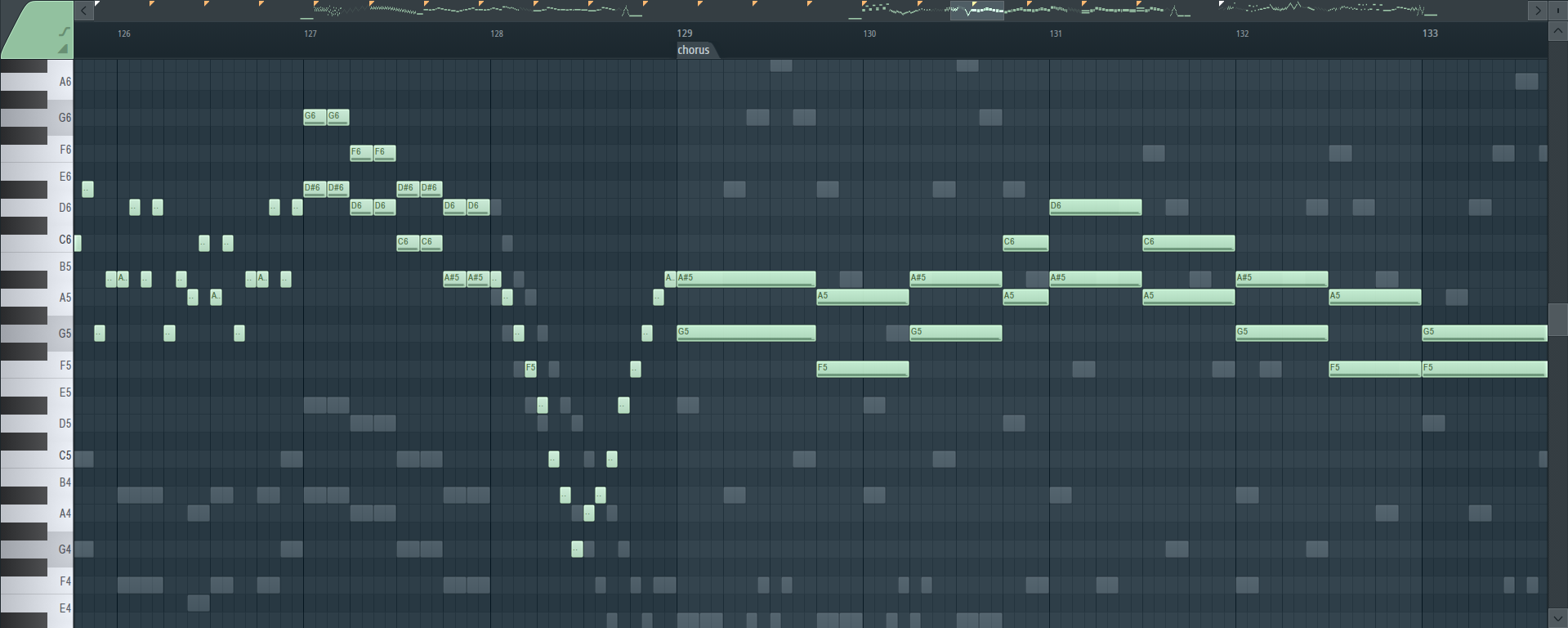
Let's address the elephant in the room I referenced at the beginning: the tempo, which is 294bpm. Technically, the original song's real tempo is half of that--147bpm. But I have enough experience making tracker music to know I'd have to double the tempo and the length of all the notes to have finer control over shorter notes (this is an extremely common technique when using trackers). Now, for better or worse, that meant it would've been a shame to not take advantage of the enhanced precision--and I did just that.
The riffs I came up with are pretty insane. They are similar to those composed by Mr. Sakoda 36 years ago, but way more complicated--no human being would be able to hit all the notes correctly, unless he were on cocaine and bullet time. The same can be said about the keyboard and guitar solos, to be honest. Some of them are based on the original melodies, and that's quite cool because they are recognizable and fit the song well. After the second minute, there is a little part which leads into the final chorus in G# minor (most of the song is in regular G), and then the coda.
After the sketch was done, it was time for the real madness to begin on Furnace.
Copying the notes was mostly trivial, like it always is. The instruments? The same ones I've been using for a while. Chunky bass with the total level of one of the operators raised for a higher-pitched slap sound, custom Orwell rhythm guitars, lead guitar and synth strings, "trumpet synth", Thunder Force IV intro synth to enhance the rhythm guitar in some sections, some Time Trax guitar by Tim Follin here and there, Batman orchestra hits and Arachno Soundfont power drums. The formula? The usual: bass on FM 1, panned rhythm guitars on FM 2 and FM 3, lead melody on FM 4, detuned echoes on FM 5, sampled drums on FM 6, square waves for support and noise for hi-hats.
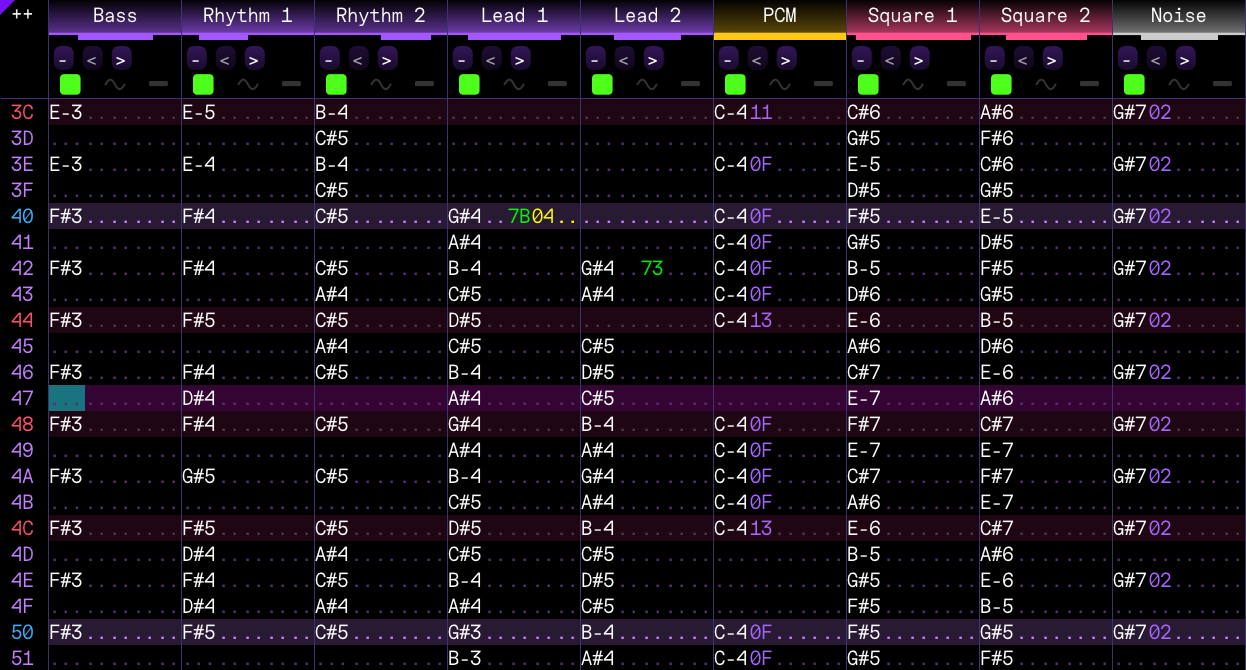
This song presented an interesting opportunity, because in the original version only the YM2612 is used. Yeah, for whatever reason, the boys at Compile completely ignored the console's secondary sound chip. They didn't use any samples either, so my guess is that since the console was still somewhat new, they didn't really know how to program a sound driver that took advantage of its full capabilities. Thankfully, I don't have that problem, and so the first minute is almost identical to the original except for the superior FM instruments, sampled drums and use of the PSG. But once that's over... hoo boy.
It's one thing to hear the sketch with General MIDI instruments on FL Studio, but it's quite another to expand upon it massively on Furnace, which is really what I'm best at. Lots of extra touches, pitch slides, vibrato, stereo effects, and so on (even some arpeggio macros). I was able to harmonize the square waves with the main melody in some parts, and it's really effective. The drum patterns are... well, let's just say I live in a world where "snare + 4 kicks at 294bpm" is the name of an actual sample I used, and somehow that makes sense. All of this is normal. This was a delicate balancing act, however. 294bpm gives me the opportunity to push the intensity past the point where it makes sense to the human brain, which I didn't want to do (I'm human too, don't you know). I think the key concept here is *occasional excess*. There are sections where it's so nuts it really is too much, but then it goes back to something that's just below the threshold of lunacy. This means that this piece puts you right at the edge between "too much" and "over the fucking line", yanking you back and forth until it ends.
Quite an experience, if I do say so myself.
I really don't think I can make faster music than this that's still, you know, music. There are other ways of achieving heaviness in metal, which is the whole reason groove metal came to be in the early 90s, as thrashers realized they'd hit a dead end. I personally think my previous Demetori cover / arrangement proves this: it's perhaps equally as nuts as this, but it's heavy because of the chugging djent riffs, not sheer speed. We'll see where we go from here. The realization that I'm capable of composing original music that actually sounds good has been quite a revelation, and it has changed my priorities from covers and sound design to composition. This piece combines both in an excellent way, and I don't think I'll ever switch to making only originals, but still: the future of the MetallicOrwell saga is somewhat uncertain (in a good way, I'd like to think).
In closing, I'd like to address a certain concern (?) that comes up from time to time when I make something especially intense. Every now and then I'll get a comment to the effect of "there's no way a real Genesis can handle this, it would melt", which I find endlessly amusing as well as quite flattering, if I'm being honest. Like all the stuff I make, this is a tracker sequence for real hardware, not an imitation: it can be put into a ROM and played on a real Mega Drive / Genesis if you have a flashcart. I have several Mega Drives around the house, and I can tell you all of them are still very much functional even after being brutalized by my music. But don't take my word for it--have a look at this instead:
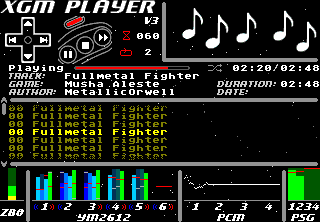
This screenshot was taken on an emulator (Blastem) for convenience and picture quality, but it's the same thing. On the bottom-left corner, you can see that the load of the Z80 (the console's sound CPU) doesn't even reach halfway through. Seriously, Sega's 16-bit wonder can handle a lot more than you think.
See you around.
Back to the index