EARTHION REVIEW
Originally written in August of 2025
By MetallicOrwell
I've seen people referring to Earthion as a "great game", but this term isn't nearly superlative enough. "Masterpiece" gets a little closer, even though it feels overused nowadays. "Miracle" or "ambrosia" feel like they get much closer.
Yes, I think I'll go with ambrosia. I'll drink Koshiro and Wada's ambrosia any day. In fact, I do it every time I play Earthion...
Ahem--excuse my crude language. Moving on!
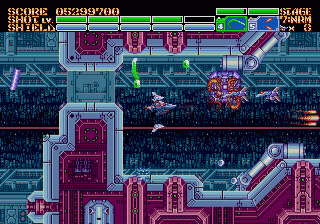
What makes Earthion what it is isn't a single specific thing you can point to while ignoring all the others. It's not that the graphics are fantastic, the music and sound effects some of the finest ever on the Mega Drive / Genesis, or that the gameplay is an amalgamation of everything that makes traditional shmups great-- it's that the level of polish and care involved in its making are nearly superhuman. This is a game you play and don't believe it can actually exist, especially when it's running natively on 4th Generation hardware. Sega Saturn shmups aren't this good. This sounds completely nuts, but I'd be dishonest if I said otherwise.
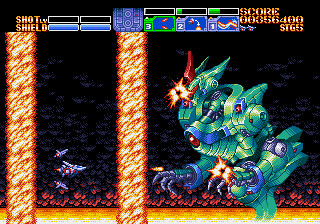
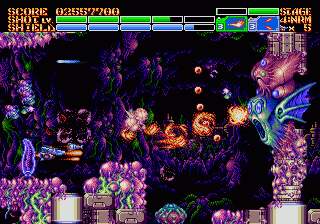
What's somewhat funny about Earthion is that the special effects, if you can call them that, aren't really all that. What I mean by this is that Earthion is no Red Zone or Toy Story. There is no insane, complicated code to get 150 colors on screen at once, no 3D engine resembling Wolfenstein 3D, no sequenced Amiga music using the 68000. The scenes of the ship moving into action are just 3D animations stored frame by frame on the ROM and shown on screen. The way some enemies fly into the playing field is just moving their 8x8 tiles in a certain way. Clever, but not groundbreaking. You'll notice that the backgrounds are often somewhat simple in order to save VRAM for the gigantic bosses. Again--using the Mega Drive's capabilities within limits, it's just that it is done so incredibly well.
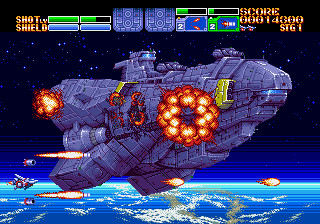
When people discuss this game they love to swing off Koshiro's nutsack (and believe me, I'm a fan of the practice as well) but you cannot forget about Makoto Wada, the other half of the team. He did the pixel art--every gorgeous, humongous spaceship and bosses that you see, the programming, and the impeccable design under Koshiro's watchful eye. It's these two men who have made Earthion what it is, and both of them deserve 50 coupons for blowjobs.
Earthion is the size of a small Neo Geo game, and it bloody well shows. For comparison, Thunder Force IV, often hailed as the best Mega Drive game in the shmup genre, is only 1MB, whereas Earthion approaches 8MB (I'm quoting Koshiro here). This has not gone to waste. It has undoubtedly enabled them to include so many detailed, huge bosses and so many samples, not just for voices, but also for all kinds of snare, hi-hat and cymbal sounds to enhance the drumming far beyond anything ever done on Sega's 16-bit apotheosis of home console engineering.
Speaking of that, I suppose we might get it out of the way, no? Let us discuss Earthion's sound, then.
Koshiro has stated that his design philosophy for Earthion was different to that of The Revenge of Shinobi or Streets of Rage. He aimed to recreate the kind of audio from the 80s shmups he admired, particularly the Konami kind. He uses rather simple FM patches (no extended channel 3 or SSG-EG shenanigans here), so what makes the music so very much worthy of deifying both the chips that produce it and the Ubermensch that makes them sing, is the composition itself. The OST nears the number 30 in total of pieces, and yet every single one is full of memorable melodies, intricate arrangements, and often long guitar solo-like sections that push the action forward in a way that makes it impossible not to wince in astonishment at what has been accomplished.
The style is very Japanese, very FM. You know what I'm talking about if you've played shmups on this console. Koshiro, however, seems to take inspiration from quite a few sources that aren't circa 1990 shmups, if my ears do not fail me. The track "The Purifier" sounds like a homage to Hyakutaro Tsukumo's "The Justice Ray" series, and again, surpasses them in epic, desperate intensity, and it does so using a form of sound generation inferior to what good old Tsukumo achieved on Thunder Force V. Speaking of that, "Terminal Doctrine" will remind you of Metal Squad from Thunder Force IV, as well as "Final Gambit" of Gradius.
Even though Earthion was developed on SGDK, it doesn't use XGM. Koshiro decided instead on the MDSDRV, which works somewhat differently. I suspect this was because it supports FM and PSG sound effects, whereas XGM doesn't. Far too many modern Mega Drive games use PCM sound effects exclusively, which is not only inefficient, but also creates a sound that doesn't feel like the console it's running on.
Koshiro would not have this. This man rivals Perturbator in his synth expertise, and that is in full display in the absolutely lovely sound effects, from the lasers to the 1-UP sound. THIS is how a Mega Drive game should truly sound. Not that he doesn't use PCM, mind you--he very much does, primarily for explosions (some of them from Streets of Rage 2) and voice samples, which sound like something you'd hear in Gradius. Destroy the core!
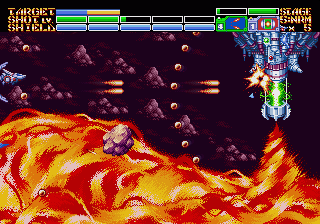
Now, the time has come to fellate the other half of the team: Makoto Wada, for he is responsible, I think, for the core of Earthion. His pixel art skills are undoubtedly brilliant, for every level delights the player with new environments and detailed, usually mechanical bosses. Again--nothing groundbreaking in the graphics department, just really well used 40-year-old hardware (and Neo-Geo levels of storage). The game can look somewhat dithered in places, but you do what you must to make the most of 4 palettes of 16 colors, and Wada does just that.
Earthion is paced quite quickly, too. Even though a full playthrough will take between 35 and 40 minutes, which is decent but on the short side for a shmup, it packs more content than many hour-long shmups I've played, and I'm looking straight at Robo (Dennin) Aleste as I type this. It will not let the player become bored under any circumstance, and does so by throwing a new type of challenge his way several times every level. It's almost exhausting dealing with the bullets, the environmental wreckage, the moving backgrounds and more, and yet you play on, mouth agape, astonished at how meticulously these levels are crafted. Not a millisecond of Earthion is a waste of time, not a single screen of a level isn't challenging in a fun, interesting way.
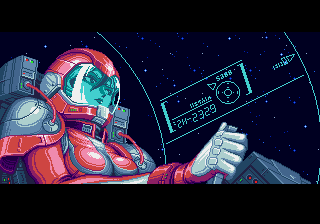
Koshiro and Wada have packed the game with such lovely details, too, like the quick time event that appears if A is pressed after selecting a difficulty. Actually using your controller to prepare your ship prepares you, in turn, for what's to come, and it psyches you up in a way that I've never really seen before. Another detail that delighted me to no end was pressing all three buttons at the same time to throw the booster and kill that one boss in one hit.
The password system adds further nuance to the already finely-tuned difficulty, as it allows you to retain your upgrades after a game over. Normal mode with no upgrades isn't the same kind of challenge as Hard mode with upgrades--again, quite nuanced. Key to this is the adaptation pod, which is brilliant also: do you take up one of your weapon slots, knowing it limits your options against the stage boss, or do you pass it up? And if you do take it, do you give yourself more health, or more weapon slots? The experience can be quite different with five slots, closer to the Thunder Force series. In addition, if you've maxed out both health and weapons slots and you want even more, you have to decide to sacrifice one of those.
Is there no end to this game's brilliance? It would seem that way.
The game has a lot of weapons, many of them familiar to the genre and easy to use, like spread shots, burst lasers and flamethrowers. But then there are the "secret" weapons, usually green in color, and here we see why a separate firing button is needed: some of them require it to be used effectively. This adds even more nuance to the gameplay: the most effective weapons have a steeper learning curve, which enhances replayability also.
What has been achieved in a home console from the 80s is nothing short of miraculous. This is not merely the best Mega Drive release from the new millennium, but easily a Top 10 game for the console ever, if not Top 5. Earthion is the difference between a game made by hobbyists, and a game made by legends.
Sometimes the thought that this might be in fact the best Mega Drive game of all time comes to me. What shall I do? And yet, is it not fitting that this would have been achieved by a team lead by perhaps the most-well known name ever associated with the console, second only perhaps to Yuji Naka?
And so I have sung the praises of Earthion with joy, and will do so again, many times.
Back to the index