for YM2612 + SN76489
by MetallicOrwell
After the madness that was The Metallic Maiden, which took almost two weeks to get done, I decided it might be time to go back to basics and do something simple for a change. Of course, making orchestral music sound good on the Mega Drive probably isn't what most people would consider "simple", but for me this is just Tuesday now. I'm always happy to cover more Chrono Trigger music, and its main theme is only two minutes of music at 130bpm, which isn't a lot, so it was the right choice. For a more detailed account of my thoughts on Chrono Trigger and its soundtrack, check out my previous write-up on To Far Away Times, as I go more in-depth there. Also, we'll be revisiting many of the same concepts and techniques, so I would recommend reading that one first if you haven't. And even if you have, a review doesn't hurt either. Anyhow--let's go.
_01.png)
I knew I could reuse the project file for To Far Away Times as well as some of the instruments, so that's what I did. We're still using extended channel three mode with algorithm 4, although this piece uses something that sounds more like an electric bass, rather than an acoustic one. Nothing that raising the total level of the modulator can't fix, though. Other than that, we have my custom Orwell Strings V2, a modified harp from Shining Force II, a brilliant FM timpani made by Mokirill for Mecha Drago, orchestra hits from Sunsoft's 1990 Batman Game (the original version this time, not the one modified by Molkirill), and a saxophone. That last one was originally the same one I used when I did the Epoch theme half a year ago (time flies), but thankfully my skills with FM synthesis have improved massively since then, so I modified it heavily to sound much more similar to the sample used by Mitsuda. There are also simplified versions of the strings and saxophone to play alongside the bass on channel 3.
019.png)
There are only two samples used in this piece: the snare, which is the same one Mitsuda used, and a special one I made for the intro. The YM2612 has extremely limited PCM sample-playing capabilities: in the words of Tim Burton from Traveller's Tales: "it's extremely limited in what it can do--it doesn't even have a volume setting". This means you can't do a fade-in like you hear at the beginning of the SNES version. That is, unless you record a few snares playing in quick succession, apply a fade-in effect, load that into Furnace and use it as a single sample. Not very elegant and definitely wasteful, but this is supposed to be a showpiece for how great orchestral music can sound on the Mega Drive, so I think it's justified. It's just a little detail, anyway.
I think I made the right call by using those orchestra hits in the verses instead of the strings, as they sound much more percussive and impactful, especially alongside the FM timpani. I kind of wish Mitsuda would've been allowed some more space on the cartridge for an orchestra hit sample, because it would've made Chrono Trigger's Main Theme sound even better. Thankfully, FM instruments only take up about 40 bytes of space (if that), so you can have as many as you want. Because I'm using extended channel 3 with algorithm 4, I have a lot of melodic voices available, so I can afford to have detuned echoes on channel 3 to make the saxophone sound much bigger as well (and also the strings in some sections). Sometimes, though, some things have to be moved over to the square waves, which sound convincing enough with everything else going on. I could've fit some of the harp melodies on the FM channels, actually, but I decided to play them on the square waves to give this piece a more Genesis-y sound in places, since otherwise it sounds nothing like what you'd imagine the Mega Drive to sound like. Also, the PSG's noise channel is used for hi-hats and crash cymbals. I'm being charitable by using that term, but they work well enough.
020.png)
Let's talk about the strings a little bit more, because the console is famous for not being able to replicate such instruments satisfactorily--obviously I feel differently. If you've listened to this piece before reading this or are listening to it now, I think you'll agree my string ensemble sounds quite fantastic. So, how did I make it? Well, in the words of Inglebard: strings vibrate a lot. But that's not a problem on the YM2612: that's what detune and the LFO are for in the first place. If you look at the screenshot I've provided below, you'll notice the operators are set to be slightly out of tune with each other by equal amounts (values like 3 or -3). That makes the sound wobble, which is the first step. But crucially, the multipliers are set really high, which massively intensifies the wobble effect. The reason for this is technical and confusing, but it doesn't matter--you just have to know that it works, because it does. Of course, this means that when you press middle C you get a much higher note, which is annoying--but that's what we have arpeggio macros for. You make one and set it to whatever you need (in this case -31 semitones) to get the sound to match the key you're pressing, and there you go. So, that's step number one.
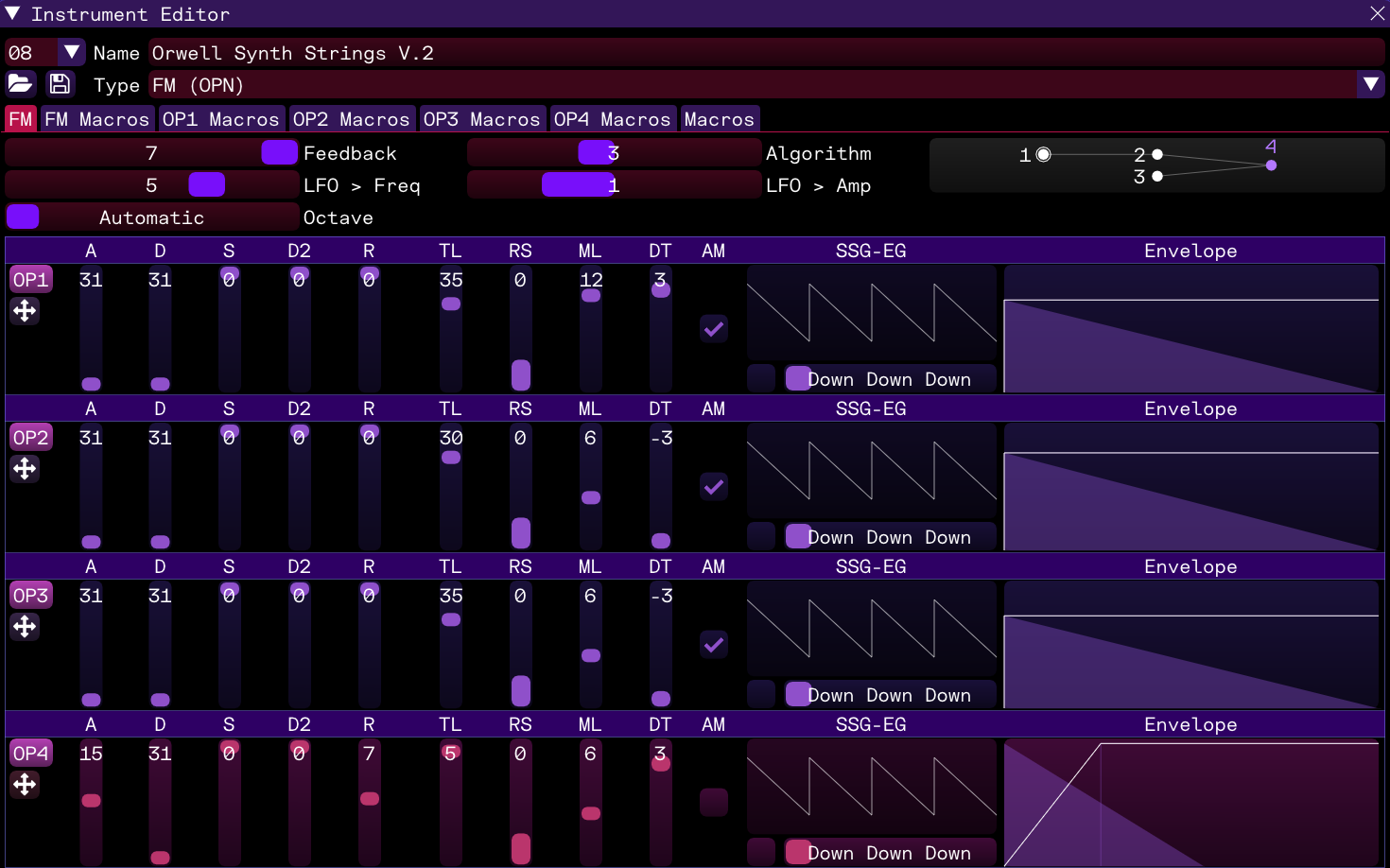
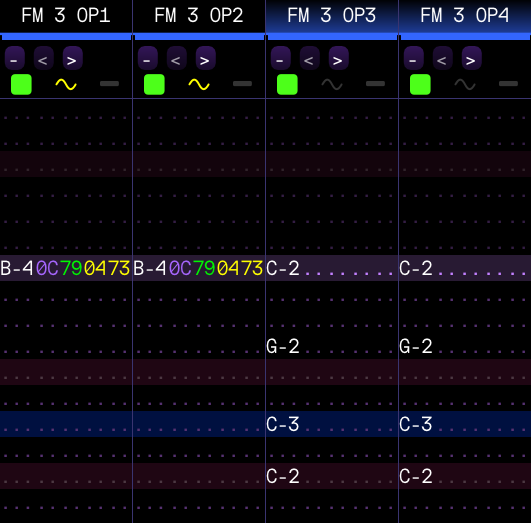
Step number two is the Low Frequency Oscillator (LFO), which was included in the YM2612 specifically to handle vibrato. On the FM macros tab, you can set its speed to whatever you want (I usually set it to 5). On the main tab, you can see the frequency modulation is set to 5 and the amplitude modulation to 1. Finally, the AM boxes for the modulators are ticked. And really, that's it. You can even have software vibrato effects on the pattern if you really need them. In fact, I did need them on channel 3 for a different reason. Let's say operators 1 and 2 are handling simplified strings, and operators 3 and 4 are handling the bass guitar. I want the strings to vibrate but not the bass, which is impossible, because since they're on the same channel, they share the same LFO configuration. That is why, in this case, I applied a software vibrato effect to operators 1 and 2 instead to get my simplified strings to vibrate, whilst the bass remains unaffected.
That was a mouthful, eh? Anyhow, when you have chords using my strings, they all vibrate together at different frequencies, obviously, so they sound fantastic. I do have other versions of this instrument made to sound duller, so that when it's playing a high note (getting closer to that dreaded octave 7), it's less piercing. In fact, I decided to record this song on real hardware in order to take advantage of the low-pass filter to eliminate any remaining shrillness, just like I did last time when I covered the ending theme. It's quite interesting because on my primary Mega Drive (Japanese Model 1, VA6) the PSG is quite loud, louder than on Furnace, so I had to make some small adjustments to the volume.
And that's just about everything I have to say about this piece, I reckon. This write-up has focused on Chrono Trigger's Main Theme being a kind of catharsis for me after The Metallic Maiden--I haven't talked about what the game and its music mean to me at all. But again, I'd recommend checking out my previous write-up on its ending theme, To Far Away Times, for that. That one's a bit more sentimental.
It's kind of relieving to know I'm not done with covers despite all the expansions and original material I've done recently. This has been somewhat of a grounding experience. We'll see what happens next.
See you around.
Back to the index