Chrono Trigger ~ To Far Away Times
for YM2612 + SN76489
by MetallicOrwell
And so, I return to Chrono Trigger once more. The idea of arranging its ending theme came out of nowhere suddenly, but one look at the song's guts and I was convinced I'd do it justice. I had the instruments I needed and I knew how to allocate the channels. I saw the solution to the puzzle in my head immediately--I've been doing this for a while, after all. Now, was I wrong? Was I too confident (that tends to happen)? Did I get my ass kicked by the complexity and nuances of the piece? It's happened before, after all...
Well, I wouldn't be doing a write-up about it if I didn't think I'd done a damn fine job. I did encounter some unexpected challenges, however, and we'll get to those soon enough.
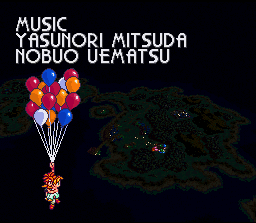
Yasunori Mitsuda worked really hard to make a soundtrack worthy of one of gaming's all-time greats, so much that he gave himself stomach ulcers in the process. A Japanese guy overworking himself--classic. Regardless, he made it happen, and many people's childhoods were made more magical than they would've been otherwise thanks to him, mine included. I have arranged several of his pieces for the Mega Drive already, like Secret of the Forest, Corridors of Time, Wings That Cross Time and Schala's Theme. This music is special to me, plain and simple. Now, To Far Away Times here might be the best track in the entire game, as it combines the tender feeling of tearful goodbyes with the uncertainty of the passage of time in a masterful way. It evolves, it changes mood, and despite it all, it feels coherent throughout. It perfectly conveys the end of the boyhood dream that is Chrono Trigger and perhaps foreshadows what's to come. We don't talk about Chrono Cross in this house, though. Nope.
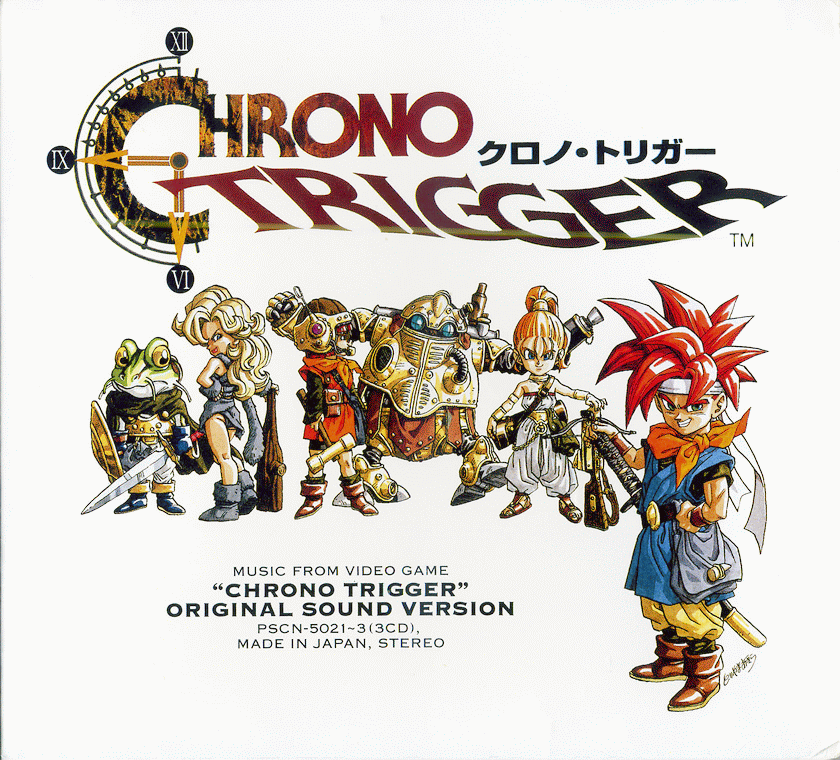
From a more technical perspective, it uses the Super Nintendo's audio capabilities well, but more importantly for this arrangement, it contains the kind of instruments that make that console's sound special: namely its distinctive, lo-fi string ensemble. It is notoriously difficult to replicate in mid-end FM synthesis, but I think I've been able to do it. Let's do the usual technical thing.
To begin with, this piece features an acoustic bass, so using extended channel 3 mode was a no-brainer. For the uninitiated, it essentially allows you to have each of the 4 operators of the YM2612's FM 3 channel play notes independently of each other. Now, algorithm 4 arranges the operators so that you have two 2-OP instruments in parallel. Putting two and two together, we can deduce that we can use this trick to have two mostly independent instruments in a single channel, increasing the number of voices of the chip from 6 to 7. These two are simpler instruments, of course, but you only need 2 operators to make a perfect acoustic bass, so I can use the other two to have a simplified version of whatever's playing the main melody for out-of-tune echo. This is what I did when I arranged Tifa's Theme, and it worked perfectly. Again: it doesn't need to sound identical, just convincing enough to work as an echo track.
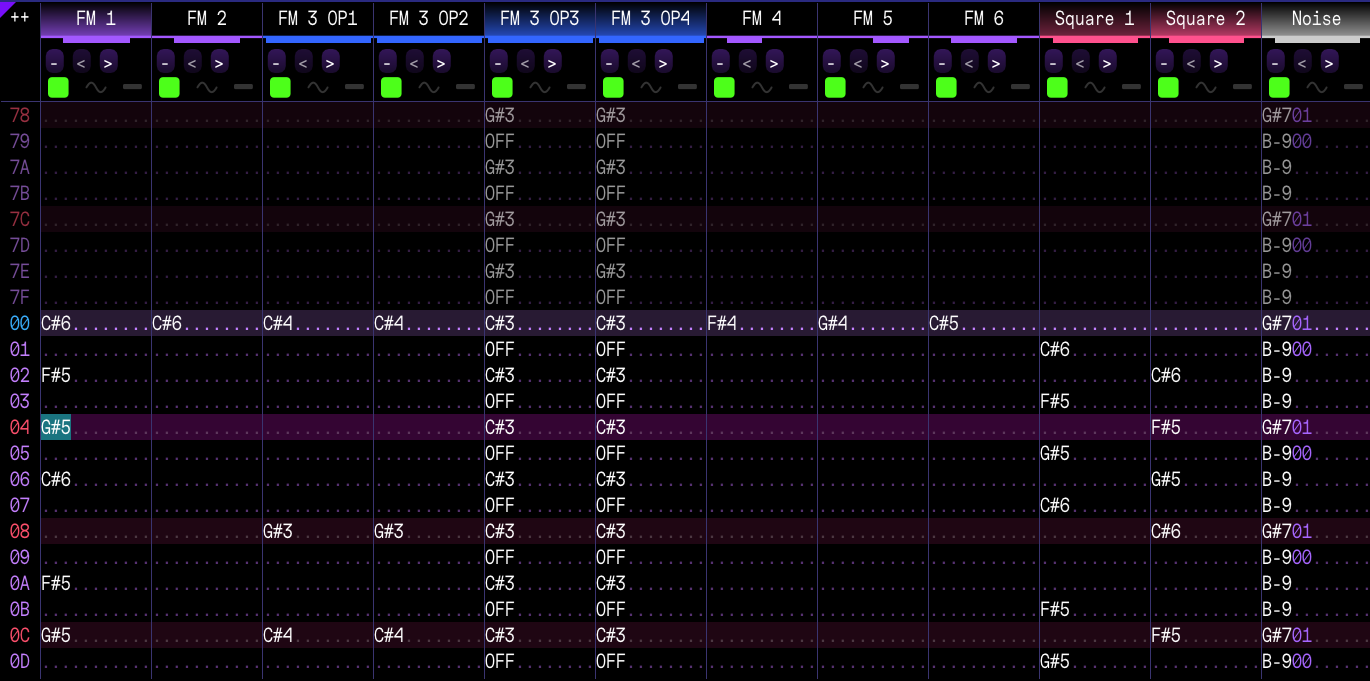
As the song begins, we have an orchestral harp, originally from Shining Force II but heavily modified, with tons of echo channels, as well as the acoustic bass I mentioned before doing its own echo in channel 3. The hi-hats are done with the noise channel, and I had to experiment a little to get the sound I wanted, but I think I got reasonably close. There's even FM noise to do the hi-hats' echo in this first part (now that's weird). I believe I've said before I can do mellow, but I never do minimalist. Anyhow: as the song goes on I can't afford to use three FM channels for a single instrument's echo, obviously, so the square waves have to do the harp's echo instead. Regardless, the core idea remains fairly simple: out-of-tune echo makes an instrument sound much bigger, and that really helps to enhance the overall impact of the arrangement. Because I have a couple more voices in total than Mitsuda had on the SNES (thanks to the presence of the SN76489 and the YM2612's extended channel 3 mode), I can afford it throughout pretty much all of To Far Away Times.
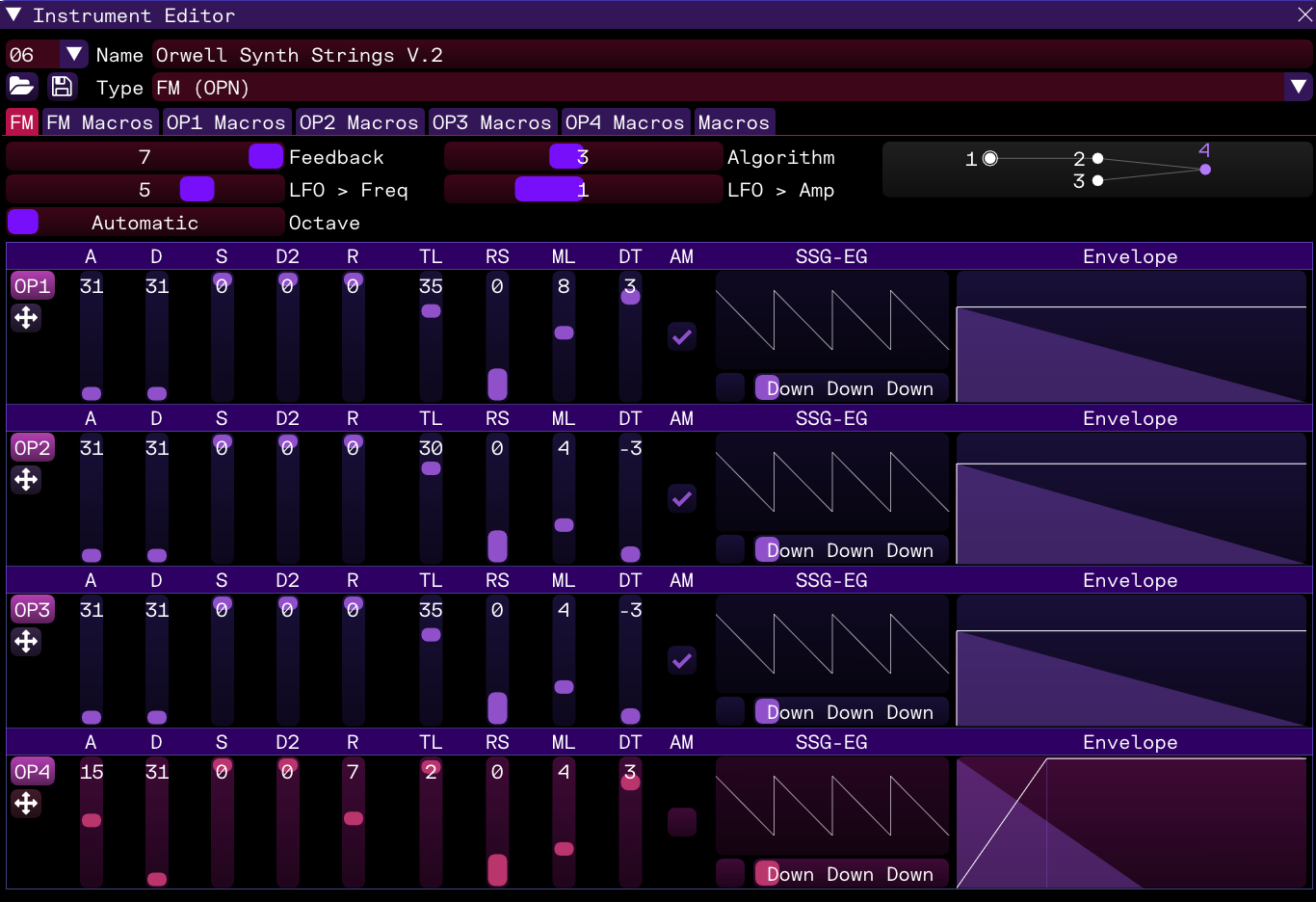
And then the strings come in. Originally I wanted to use my custom Orwell Strings, but they didn't sound quite right. So I made version 2.0, using a completely different algorithm (3 instead of 4). The flute is the same I've used in many pieces before, and since I restrained myself and barely used any pitch effects, portamento or vibrato, it actually does sound like a flute. I originally wanted to use the acoustic piano from Streets of Rage, but I just couldn't get it to sound like it does in the original SNES track. So, I pivoted to an electric piano--the one from YU-NO (PC-98, OPNA) of course. From the perspective of FM synthesis, an electric piano is really just an acoustic piano and a bell playing at the same time--that's how they're made. I lowered the multipliers on the bell in order to get it to sound a bit less piercing, although I do use the unmodified version in one specific part.
This piece is definitely more focused on the high end of the mix, especially with the strings and that goddamn flute hitting those notes in octave 7. The whole thing can sound a little shrill at times, and that was the main challenge I encountered during this whole process. I even had a family member who is particularly sensitive to high frequencies give me feedback a few times to make sure I didn't hurt people's ears while trying to make the Mega Drive reach new heights of aural excellence. At the same time, I didn't want to dull the sound too much, since the piece would lose all its power. It was a tough balancing act, truly, but I had another ace up my sleeve to solve that problem--more on that later.
There is a section where the music really swells up, and I'm just going to say that this is actually the first time that I've gotten chills while making an arrangement in a long time, maybe ever. It convinced me I'd succeeded in making excellent strings, and that this was something special overall. I did decide to use my previous version of the strings in one of the channels in this section though, since they sound less strident at high octaves. Incidentally, for this part I made a simple, OPL-style french horn and put it in FM channel 3 right next to the acoustic bass. Also, I'm using a Savaged Regime choir instead of my usual Sakimoto one, as it's mellower and better suited for low octaves.
The next section is a minimalistic one focused on the piano, and this is where I use the unmodified one from YU-NO with a lot of echo. Also, while I considered using FM synthesis to mimic the tick-tock of the clock, in the end I ripped the sample from the SNES song and used that--this way it sounds identical. Plus it's tiny (barely 1.6kb) so it doesn't bloat the song. I even have another one at a lower volume for echo. There is a pattern here, and it might be my obsession with taking something simple and making it sound like it's being played across a vast valley or something.
Right at the end, the strings come on again. Mitsuda uses three-note chords for both the strings and choirs, and in my arrangement, they're located in channels FM 4, FM 5 and FM 6. No PSG crap here: full FM synthesis to make them sound good. But oh-oh: I'm already using FM 6 to play the tick-tock sample in this part... well, here's where we compromise just a little bit and put one of the notes in channel 3 using a simplified version of the strings. You do what you gotta do. As for the next section, it's more of the same with the flute and modified piano. Finally, at the very end I double the tempo to have perfect control over the harp melody.
Now about the ace up my sleeve: I'm talking about my genuine, Model 1 Japanese Mega Drive (VA6). See, real Mega Drive / Genesis consoles from back in the day have a lowpass filter to reduce noise, but as a side effect (or was it intended also?) it obviously decreases the highest frequencies quite a bit. This doesn't happen when you're playing the module on Furnace, so the difference is pretty stark. Your mileage may vary as to whether that's a plus or not, but when you have a piece with very high-pitched instruments (electric piano, flute, string ensemble, etc.), the lowpass filter can really help to make the whole thing sound less shrill, not to mention it adds a layer of ultimate authenticity. That is why I decided to record this arrangement from a real Mega Drive's headphone jack instead of just rendering it on Furnace like I usually do.
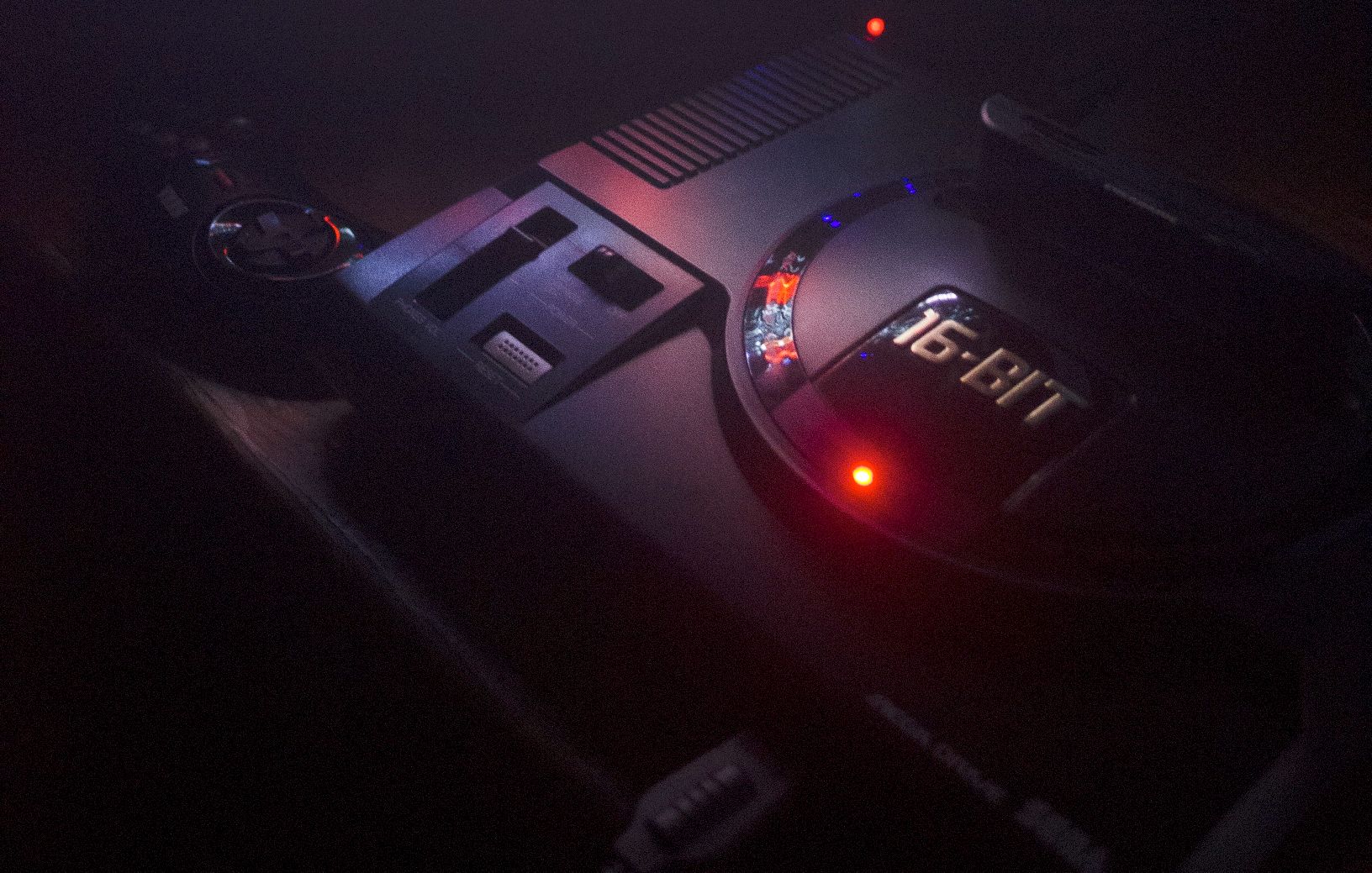
And that's To Far Away Times on the Sega Mega Drive. The degree to which I've been able to do justice to the SNES original frankly astounds me, though this wasn't without some serious challenges. Sometimes I sound insane, but maybe I am--and in that case I'm glad, because if I weren't, I wouldn't be able to make the Mega Drive sound like it can rival Nintendo's finest hour when it comes to making orchestral music.
See you around.
Back to the index