for YM2612 + SN76489
by MetallicOrwell
There are a lot of bands in the world, but there is only one Iron Maiden.
I've been a metal fan for close to two decades now, and I've listened to all kinds of stuff. From the most obscure thrash metal you can imagine to symphonic black metal, atmospheric stuff, folk, technical death metal, djent, you name it--I'd be surprised if there was even one subgenre I haven't heard of at this point. This kind of music speaks to me like no other, and I've dived deep into it. And yet, after all these years, the one band I'm always happy to come back to happens to be not some obscure, underapreciated group, but rather one of the most popular ever. Iron Maiden is easily the biggest metal band in history second only to Metallica, and in my heart they're number one. I'm not saying they're the most technically proficient, creative or talented, because they obviously aren't, or at least not to the degree that would justify their extraordinary fame. They don't even belong to my favorite subgenre of metal, which has always been classic American thrash. And yet, there's something about them that makes them immensely enjoyable, regardless of what period of my life I'm at... almost like they're timeless and immortal, just like the pyramids from the Powerslave cover art.
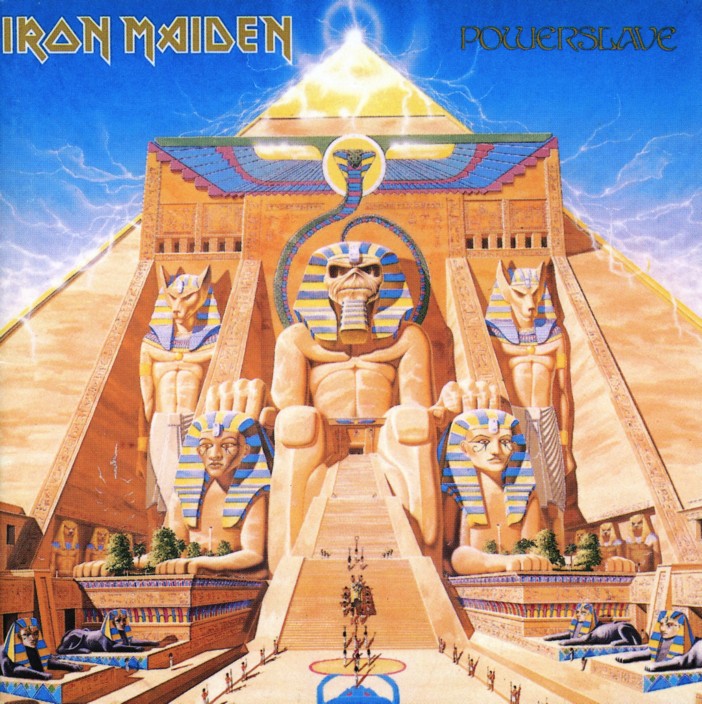
If you're familiar with Iron Maiden, you might have noticed their fans are fucking crazy. I'll try not to be an uncontrolled, blind fanboy in this write-up, but no promises, you know?
I had considered covering Aces High as far back as late 2025; it was going to be either this one or Transylvania. Part of the reason I had my doubts about doing this now was because I thought Aces High might be too simple--I've composed more complicated metal music myself (see The Metallic Maiden and especially Twin Flames), or so I had thought. Leave it to Steve and co. to kick my ass and prove me wrong, because there's a lot more to Aces High than I originally thought. Again, you never truly appreciate a piece of music until you've taken it apart and built it back up with your own hands. Another reason was that this is one of their most popular songs, and in a way, I thought if I did this instead of something more obscure I'd be selling out or something (I've definitely internalized the mentality of being the underdog, which is so common in metal). In the end, though, I'm very happy I did this cover, because I've had a blast and I've also learned a thing or two about composition. Let's do this.

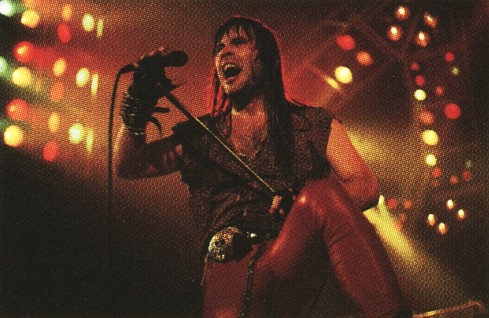
Aces High is, of course, about the Battle of Britain from 1940. As the song begins, the lyrics tell of how the sirens alert the pilots of what's coming, and so they prepare their airplanes, fly into the sky and fight the Germans. In a way, it's a typical early Iron Maiden song: an absolute shot of testosterone and heroism right into your testicles. If they did this song today, it'd be less about the excitement and danger and more about the suffering and human consequences of war. Regardless, it's clear that this isn't a case where they came up with the music first and the lyrics second, because they complement each other. In the verses where Bruce Dickinson is singing about the alarms and preparations for the battle, the music is tense and urgent. During the pre-chorus, he describes the actions the pilots are taking once they've already begun fighting, with short, impactful words like "rolling, turning, diving", and the music sounds more exciting. The chorus is where the heroism fully kicks in, and you can perfectly imagine yourself flying and shooting as you try to sing along to the words with the voice of someone who doesn't have a clue how to sing, but can't help himself because the song is so incredibly exciting.
I've only talked about the lyrics so far and I already sound like I'm raving. This is gonna be a doozy.
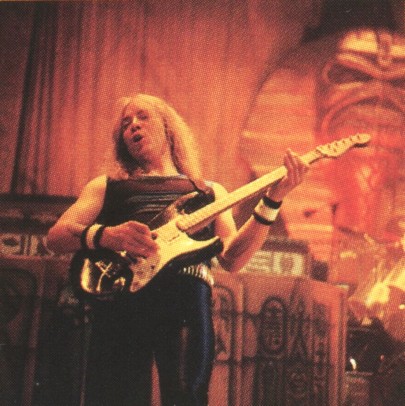
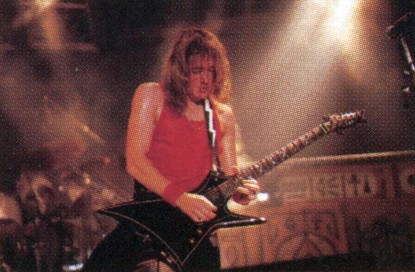
Musically, Aces High is in the keys of F#, A, E, and G minor (that's a lot keys for just one song) and it also has an interesting structure, because it doesn't use the typical ABABCB formula that Iron Maiden are so fond of. It has an intro with guitar harmonies, aggressive riffs in the verse and pre-chorus, and open power chords in the chorus. Then, instead of repeating the previous verse like you'd expect, they go straight to the bridge, which combines both approaches: there is what I like to call a "transition riff" at first and then power chords during the part with the solos (Dave Murray goes first and Adrian Smith second), and then we use the transition riff again to go back to the verses, albeit with different lyrics. Once we're done with the final chorus, we get the guitar harmonies again, and finally the outro with a big rock ending. By arranging the song in this fashion, they avoid redundancy to some extent, and it works. Placing the bridge after the first chorus instead of the second one throws you for a loop, because you don't expect it, and by the time we're back to the verses, you want to hear them again. Also, there's no need for a third chorus. This makes the song less bloated than it would have been if they'd stuck to the ABABCB formula. Instead it's lean, mean, and utterly brilliant.
There are a few tempo changes in Aces High: the intro is at ~80bpm, the main part at ~130bpm, and of course it slows down a lot during the big rock ending (~107bpm). Now, why the approximations? Because Iron Maiden don't play to a metronome, and in fact I think they often record their studio albums like a live band (I guess that's the rock 'n' roll way). This means that there is *a lot* of tempo drift in this song, and while it's not enough to be distracting if you're just listening to the song without analyzing it with a magnifying glass like an absolute lunatic, when you're trying to make a cover it's impossible to get it exactly right. It's constantly speeding up and slowing down just a little bit; how the hell do you sequence that without going mad? You really can't. The one exception is the part with the repeated harmonies before the outro: it's way, way faster than the first time it's used (near the beginning of the song). So what do you do? Well, I chose to keep the tempo consistent to save myself a headache. Disappointing, I know, but you're not gonna notice either way. Still, I have a tendency to think about the minutiae when I do these things.
Now let's talk about Steve Harris and his crazy shenanigans, because I have a lot to say. It's been said a million times, but the way he plays the bass is very, very unusual in metal. Normally you'd either follow the guitar closely or just play the root notes: keep it simple, keep it tight and lock in with the drums, maybe add just a little bit of flourish here and there if you're feeling adventurous. Not Steve Harris, or at least not most of the time, and most definitely not in this song. Instead, he comes up with basslines that often feel completely independent. He'll complement the guitars, or just do something different, often playing the notes a whole octave higher than you'd expect. In the chorus, while the guitars are playing simple power chords, he's off playing his own unique riff. I imagine he can get away with all this crazy shit because, well, it's his band. Most bass players aren't so lucky, are they?
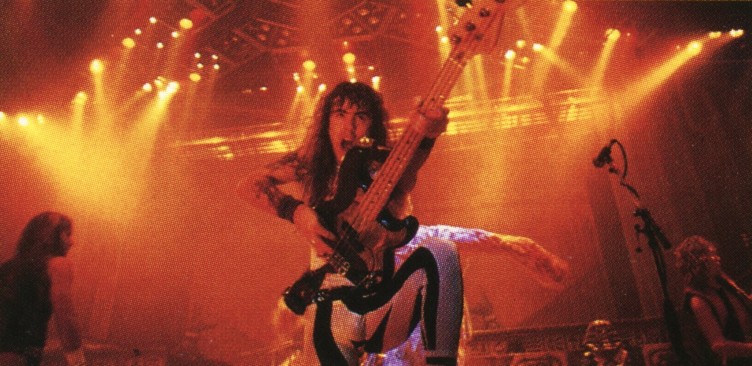
In all my years listening to metal I've never come across any other band where the bassist plays quite like this, and that's a little strange, because Iron Maiden are enormously popular, and Steve Harris is the foundation of the band, as well as its most famous member, probably. You'd think metal bassists everywhere would be copying his style left and right, and yet I don't think they do. Why not? Well, Janick Gers once said that the whole sound of Iron Maiden is based around the way Steve Harris plays bass. In other words, he's the leader of his own band as well as the main composer (especially in the early days), so it makes sense that they'd have no choice but to base everything around his unorthodox style. He can get away with it, basically. But the reality is that basing the sound of a metal band around the bass player is fucking ridiculous, so people don't do it. You can't even hear the bass in most metal albums, for God's sake. For the most part, metal is all about the guitar, so *that* is what dictates everything else, and like I said, the bass either follows it closely or just plays the root notes, because it just works. I'll say one thing: covering Aces High has definitely inspired me to get more creative with my own bass parts, so we'll see what happens when it's time to compose another original piece.
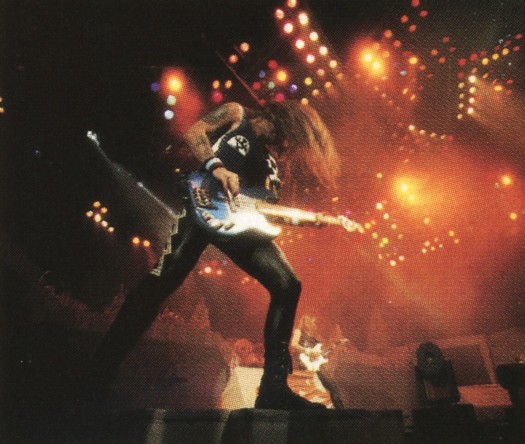
Another lunatic I'd like to talk about is Nicko McBrain. I mean, you'd have to be one to keep up with the other crazy bastard in the rhythm section, right? I used a splitter to study (and I do mean study) the instruments independently, and that revealed a lot of interesting things. Nicko often adapts the kick drum pattern to what Steve is doing, and there is a lot of variety to how he does it. Sometimes he'll change it up mid-verse, or just do anything other than what you'd expect, while still being coherent. I suspect this might have been improvised to some extent, but I have no proof of it. Now, Nicko is famous for using a shitload of toms, and he puts them to good use here with a lot of fills. What's really fantastic is that they are different even when the verses are repeated (except for the lyrics), and also more intense the second time around, which is fitting. I replicated them here fairly closely, but there is no way to know exactly what he's doing during the big rock ending (unless you can just tell because you're a drummer by trade or something, I suppose), so I came up with most of it myself. It works well enough. By far his coolest moment, though, has to be the fill before the second pre-chorus. It comes right after Bruce sings "heading straight for them, I press down my guns", and it's nothing special, he just hits the snare eight times in a row. But it sounds like a gun firing, so it fits the lyrics, which makes it a lovely detail.

I think I might actually be out of things to say about the song, so let's finally talk about my cover here. I allocated my channels like I usually do when I make metal covers on the Mega Drive: on the YM2612, channel FM 1 is for the bass, FM 2 and FM 3 for the rhythm guitars, FM 4 and 5 for the leads, and FM 6 for PCM drums. On the SN76489, the two square waves provide support and the noise channel is for hi-hats and crash cymbal backup. I didn't use my beloved chunky E. Bass 70 instrument here because Steve Harris doesn't sound like that--instead, I favored the fingered bass instrument I pilfered from that one SilverRIFF .dmf a while back. Throughout most of the song I use my custom Orwell R. Guitar patch for the rhythm guitars, and several variations of my Orwell Lead for, well, the guitar leads (and solos). As for the vocals, I used several brass patches. One of them is a modified version of the one from Master of Monsters by Hitoshi Sakimoto, and the other, which I used on the chorus, is from that one SilverRIFF .dmf file--I have no idea where it came from originally. I think the brassy sound fits the heroic nature of the song quite well, however, especially in the chorus. During the transition riff, the "lead channels" are used for additional rhythm heaviness by using the synth instrument from the intro to Thunder Force IV.
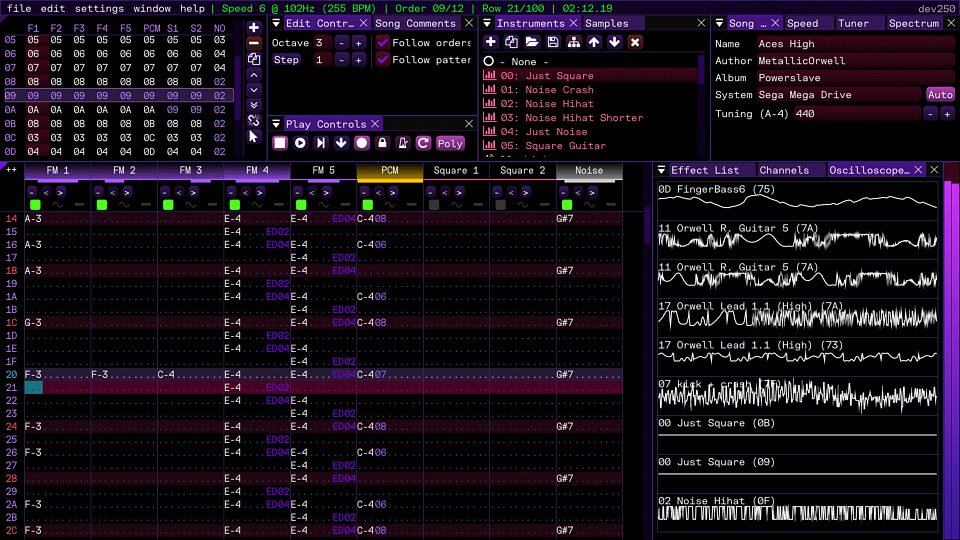
It's mostly business as usual, but the guitar harmonies at the beginning and the end were difficult to get right. The thing is that I either have electric guitar patches that only sound good at low octaves (good for rhythm in metal) and patches that only sound good at high octaves (good for solos), so I had to find a solution for the mid-range. In the end, I had to combine one of my Orwell Lead instruments with a heavily modified version of the lead guitar from Metal Squad (I think that's where it's from, but I have so many FM guitar patches on my folder that it's easy to lose track of where they came from sometimes). I played some of the notes on one instrument and the other set on the other, and I also had the square waves play the notes one octave higher at a low volume for a cleaner, fuller sound. I also studied the guitar solos by listening to isolated tracks, loading them in Audacity and using the plot spectrum to get the notes right (I'd say I got close). I added a lot of detuned echoes everywhere, of course. Finally, the drum samples are the ones I normally use: kick, kick + crash, snare and snare + crash from the Arachno Soundfont power kit, and three toms from the Yamaha MU-2000 EX.

The result of all this is a massive sound that is quite a bit more produced than the original recording from 1984, but I think it works really well. Again, I'm glad I did this cover, because even though getting it to sound right wasn't terribly difficult (aside from the harmonies in the mid range), by analyzing the song I learned a few things, mostly about changing the key several times mid-song, which is probably one of those things you don't naturally pick up on unless you make music with real instruments (or analyze it, like I've done here). Also about making music and narrative work together, because that's what Iron Maiden did in Aces High marvelously well. Maybe my next idea for a song could begin with a theme or a story, rather than just observing, analyzing and recombining musical ideas.
I could end this write-up with something like "Up The Irons", but that's Steve's own little thing he came up with; it's related to his favorite soccer team, and I don't follow sports. Instead, I will share a personal anecdote. I saw Iron Maiden live only once when I was 19, and they started the concert off with Aces High. When the lights turned on and I saw them running across the stage, I experienced a feeling of euphoria that has never been matched, even after all these years. Maybe I need more experiences... or maybe I need to see them live one more time before the inevitable end. All things considered, I think I've been a pretty reasonable and contained fanboy in this write-up, especially when you consider the subject is the band responsible for the best time of my life.

See you around.
Back to the index