Thunder Force V ~ Rising Blue Lightning [S.S.H. Victory Mix]
for YM2612 + SN76489
by MetallicOrwell
Just when I thought I was out, they pull me back in! I didn't have any intention of going back to this style so soon, but I've been rediscovering Thunder Force V (my favorite shmup ever) lately. In fact, I've just beaten it this week in hard mode without continuing for the first time ever, and seen the game's real ending and credits after so very many years of playing it. So, I have had Thunder Force V on the brain lately, which has resulted in this. It's time for the blue lightning to rise, indeed... not on Saturn or PS1 hardware, but on the Mega Drive.
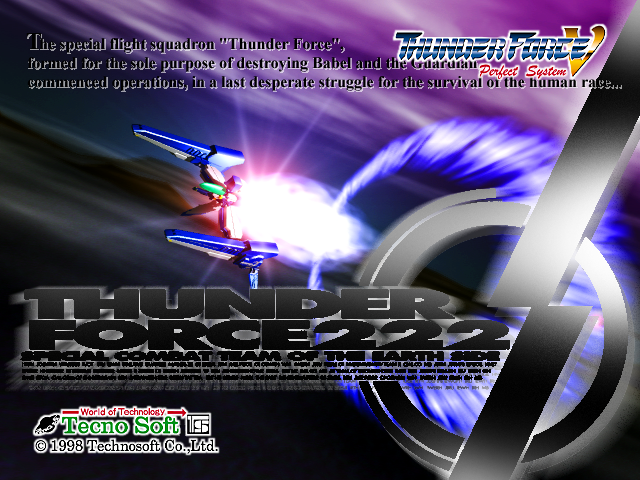
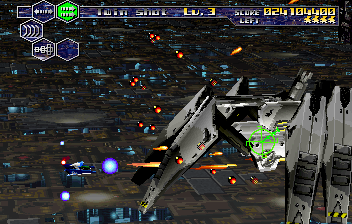
Picture this: it's the future, and there's been a hostile AI takeover (poignant, huh?). Humanity is in a desperate situation, but they've been able to develop a revolutionary new fighter craft and form a squadron (named Thunder Force, of course) which is now launching into one of its missions. They are engaging enemy forces amid a ruined city that's now being rebuilt, trying to defend not just the buildings and the people, but the very concept of getting back on your feet after a tragedy. The music that plays in this level--Rising Blue Lightning by Hyakutaro Tsukumo--perfectly captures the heroism of the pilots who are facing overwhelming odds gallantly, with its galloping, B minor core marching on towards the abyss with bravery and determination.
Now, you know me: where there's a Thunder Force song to be arranged, there is Saitama Saisyu Heiki to take inspiration from. Interestingly, our OG VGM Headbanger did two versions of Rising Blue Lightning. The first one was made for the Yamaha MU-100 in October of 2000, and he sure metalized without an ounce of remorse. He did away with the Iron Maiden-like gallop, included tons of solos and played around with the structure quite a bit. However, because of that, while as an individual piece of instrumental power metal music it's good, as an arrangement of Rising Blue Lightning it doesn't work--even if it does have some nice touches, like the thunder sound and the tubular bells. S.S.H. was smart enough to realize this, of course, which is why he did another version for the MU-2000 on the summer of 2001. This time he stuck much, much closer to the original, even stating in the readme that that was the whole point of this second take--but then the problem is reversed: not enough new elements. The song plods along in the second half, repeating melodies from the first until it ends. Funny, no? The first time he went way too hard, and the second time he played it too safe.
Well... what do you say we do something about that?
To begin with, Rising Blue Lightning is a surprisingly straightforward track. It has a heavy metal backbone to it, which of course means my metal formula (FM 1 for bass, FM 2 and FM 3 for rhythm guitars panned to each side, FM 4 and FM 5 for lead melodies, FM 6 for PCM drums, Square 1 and 2 for support and noise for hi-hats) fits rather well, but not perfectly. If I had used it like I normally do, I would've been making the same mistake as S.S.H. by murdering its mood and atmosphere at the altar of headbanging madness. See, normally I'd use FM 4 for lead guitar / synth and FM 5 for out-of-tune echo (and in fact I do that in some parts), but in order to maintain the mood, I need synth strings--and not that PSG crap, but my custom ones. So, for a good part of the track, the rhythm section gallops along while FM 5 handles the lead melody and Square 1 does the echo. This way, FM 4 is free to use strings that actually sound like strings. The second square wave can be used to play more notes that add to it, but by themselves, square waves do not carry the same emotional weight.
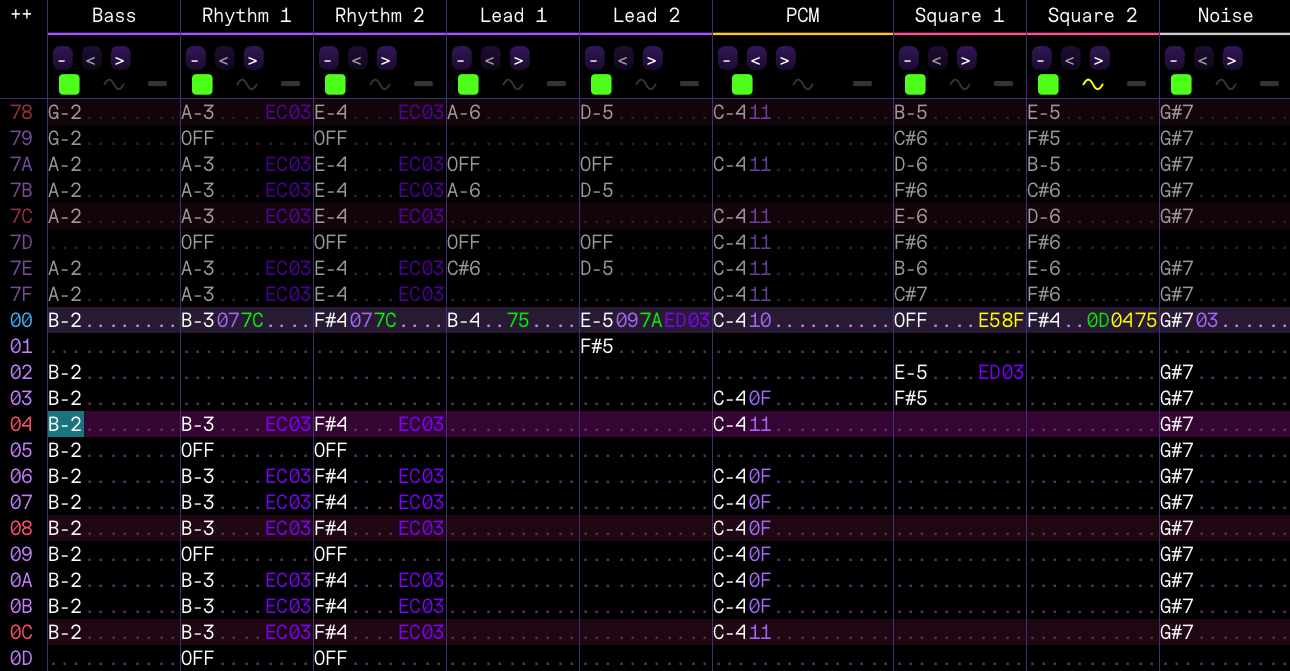
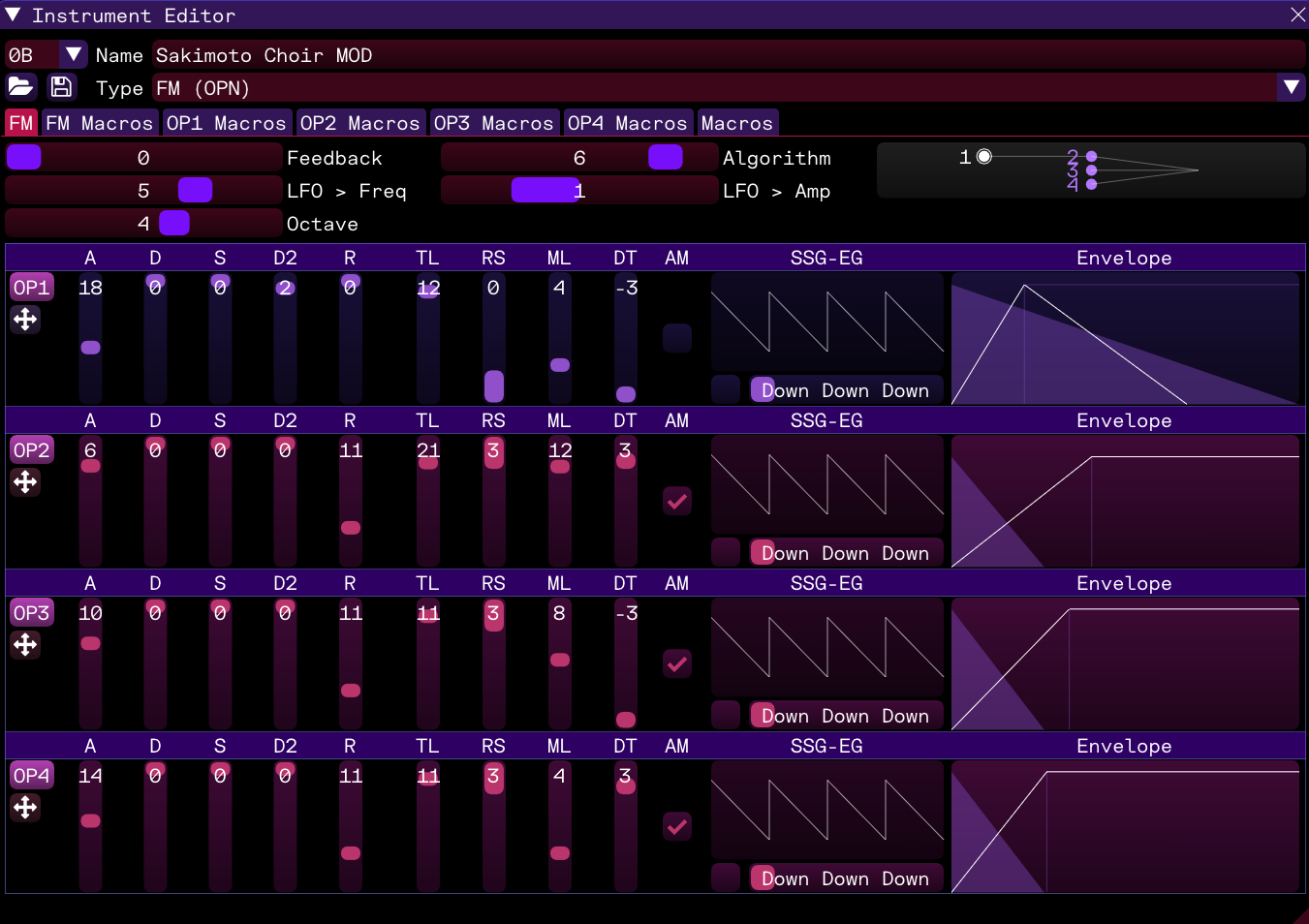
I mentioned the rhythm section already, so let's explain that in more detail. The bass is a little different than usual: Tsukumo's original uses a slap bass with a very noticeable pop. So, I tweaked the Electric Bass patch I normally use (included with Furnace) and raised the multiplier of operator 3 to twelve, giving it a very strong initial high-pitched slap without sacrificing the lower end. I also changed the galloping pattern slightly and accented it with hi-hats. The rhythm guitars follow S.S.H.'s rather closely, and the drum samples are from (wait for it) the Arachno Soundfont. Now that's the surprise of the century. I do use a different power snare, just for variety's sake. Incidentally, I didn't go particularly hard with the drums during most of this arrangement because the song doesn't need it.
The harp-like glissandi are handled by the square waves with out-of-tune echo, which works perfectly. As for the lead melodies, we have a decent variety of guitar and synth sounds, including my custom Orwell Lead, "trumpet synth", and a tweaked version of DefleMask's Synth Lead 7. In the guitar slide at the beginning, I'm actually using the rhythm guitar from Battle Mania Daiginjou, as it's perfect for it, though I use my custom rhythm guitar throughout the rest of the piece. We have a further tweaked version of the orchestra hits from Sunsoft's Batman in one early section, and of course, as I mentioned, my synth strings see some heavy use. In some sections, though, I use a further modified version of Sakimoto's choir from Master of Monsters to enhance the mood even more.
I did think my approach to Legendary Wings worked (faithful first part, metalized second part), so this time I've taken it a little bit further. There are three distinct sections in this arrangement, and we will cover them all. What I've done here is to slice and dice different parts and rearrange them in a particular order which works to give this piece an escalating feeling with an explosive ending. Like so:
First section: roughly equivalent to Tsukumo's original. I've used S.S.H.'s 2001 remix as a base, but removed some of his garnish, restoring some elements like the pitch slides he removed--and of course, adding details all my own.
Second section: similar to the first, but shorter, leaving only four of S.S.H.'s solos and eliminating redundancy. The drumming is a little more intense here.
Final section: this is where I played surgeon the most. It's comprised of sections from S.S.H.'s earlier 2000 remix, but put together in a different order--again, no redundancy. The atmosphere is thrown out the window, my metal formula is used in its basic, ferocious way, and it ends with a little part I composed myself.
By the way: those tubular bells sound quite lovely, no? Believe it or not, they are actually the Sonic 1 Ring effect, just played at low octaves. It truly is one of the most beautiful and versatile FM instruments I've seen.
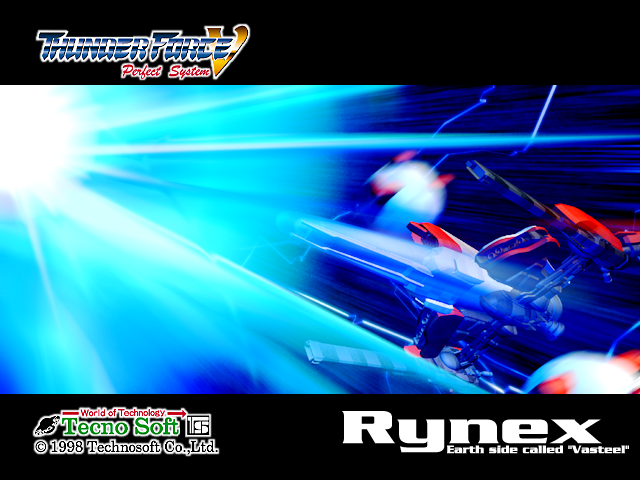
Anyhow: I believe these changes to the structure of Rising Blue Lightning to be an improvement over either of S.S.H.'s versions. Whether it's better than the simplicity of Tsukumo's original can be argued, but for stock Mega Drive hardware, this is quite a triumph. The rising tension and metal-style resolution give it a sense of finality--you could almost say that it tells a story with an energetic end. Of course, whether or not the Thunder Force squadron succeeds is up to you picking up the controller!
That's it from me, dog. There's only one thing left to say: the fact that I've done two Thunder Force V songs already begs the question about the big one--Steel Of Destiny. That happens to be my favorite piece of music from any video game ever, so not arranging it for the Mega Drive isn't an option. It's merely a question of when it will happen, and how far I will go to make it as much of a masterpiece as possible.
See you around. And of course, may fortune be with you, pilot.
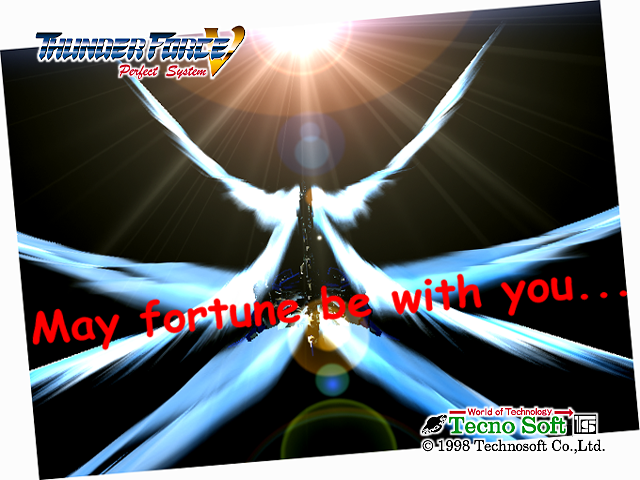
Who the hell uses Comic Sans MS, and in red, no less? Well, it was the 90s.
Back to the index