Thunder Force V ~ Legendary Wings
for YM2612 + SN76489
By MetallicOrwell
After doing Metal Squad I suppose I was left with the desire to do more Thunder Force stuff, so, here we are. Thunder Force V actually happens to be my favorite shmup of all time, controversial as that opinion might be, so arranging Legendary Wings (its first level theme) was something I was more than happy to do.
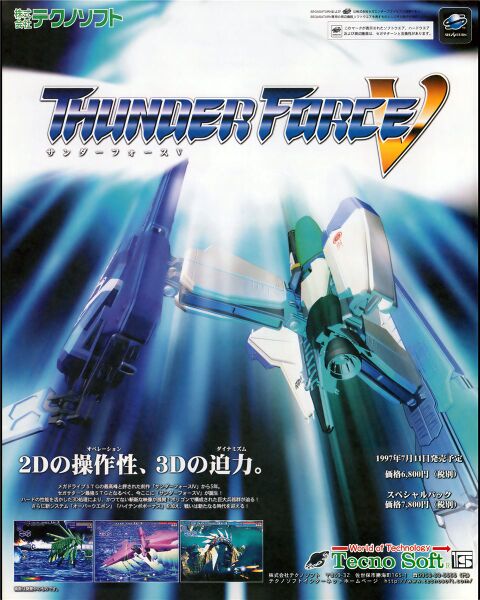
Japanese flyer
After Yamanishi left the company, Technosoft hired Hyakutaro Tsukumo as their main music composer, and he proved himself in games like Hyper Duel, Blast Wind and of course Thunder Force V. He had a very distinctive style at the time, and Legendary Wings is an excellent example of that. Given that it's a first level theme for a shmup, you'd expect it to be fast and energetic--and it is, but there's more to it than that. The synth instruments have a somewhat mellow, watery feel to them: it perfectly captures the feeling of flying across an endlessly blue sky and over an equally blue ocean on... well, legendary wings. Now, Saitama Saisyu Heiki, OG VGM Headbanger and heavy metal arranger supreme, did an arrangement of this song in late 2001 and admitted in its accompanying readme that he went soft on it (three out of five stars in his "rage meter"). He basically metalized it a little bit, but kept the mood of the original song mostly intact. Well... I suppose it's time for me to right his wrongs once more, isn't it? I'm kidding--I think.
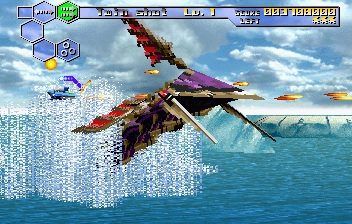
No Blue Level
I may be a life-long metalhead, but I don't necessarily want to metalize everything, and going too hard on this song would ruin its primary mood and turn it into something completely different. I kept listening to both the original by Tsukumo and S.S.H.'s arrangement, and eventually decided on a method which I think has yielded excellent results. I would stick close to the 1997 original during the piece's first "loop", and in the second I'd metalize it to my heart's content--harder than S.S.H. This way, you get the best of both worlds.
So, this uses my metal formula: FM 1 for Bass, FM 2 and FM3 for rhythm guitars panned to each side, FM 4 and FM 5 for lead melodies, FM 6 for PCM drums, Square 1 and 2 for support and noise for hi-hats and crash cymbal back-up. But because the first half of this arrangement isn't metal at all, FM 2 and FM 3 are actually assigned to some synth strings I made. This has made me realize the formula is actually quite flexible and probably suitable to a lot more musical styles than just metal because of its balanced nature. Brilliant engineering, truly. The bass is pretty distorted throughout, too, which helps to enhance the energy without relying on an electric guitar.
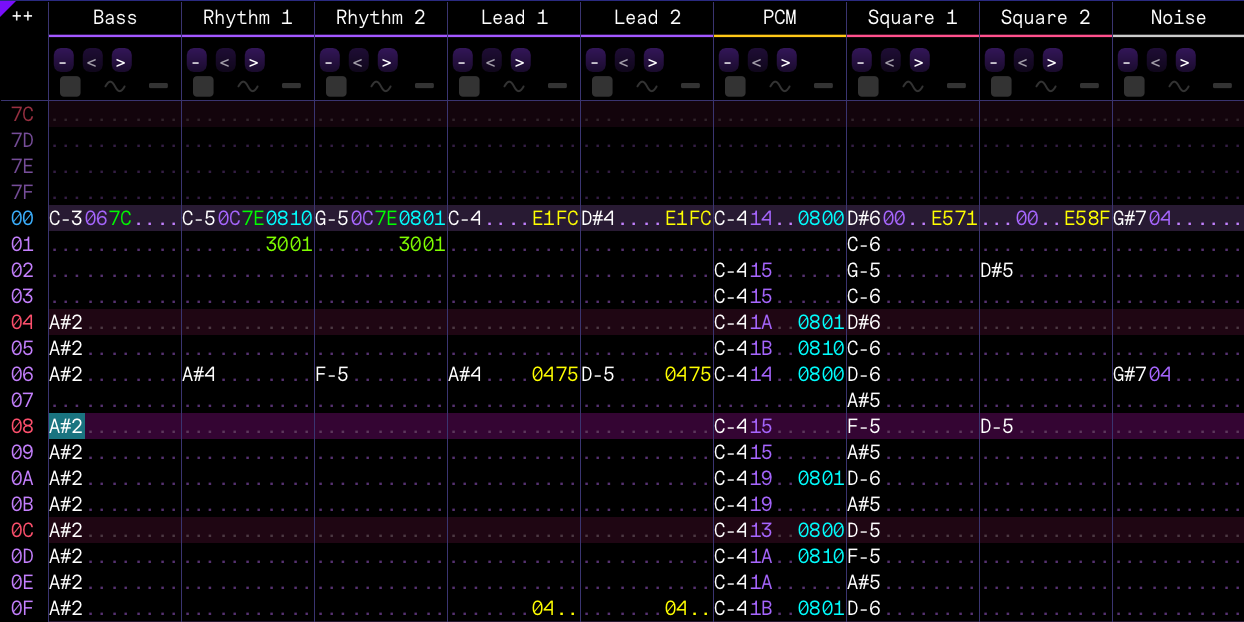
The formula
In the early sections, the leads are handled by a pipe organ, a heavily modified Sakimoto choir from Master of Monsters, and an interesting instrument called synth + crystal that I made a while back (I think for Ys III's A Premonition: Styx). See, I'm a huge fan of FM bells, especially the Sonic 1 Ring effect, but they fade out quickly, obviously--that's what little bells do. So, this instrument uses algorithm 4 to have both a simplified version of the Sonic 1 Bell, and a sharp, brassy synth sound playing the same note at the same time, just across different octaves because of how the multipliers are set. This way, after the bell fades, you don't get dead air because the synth continues playing.
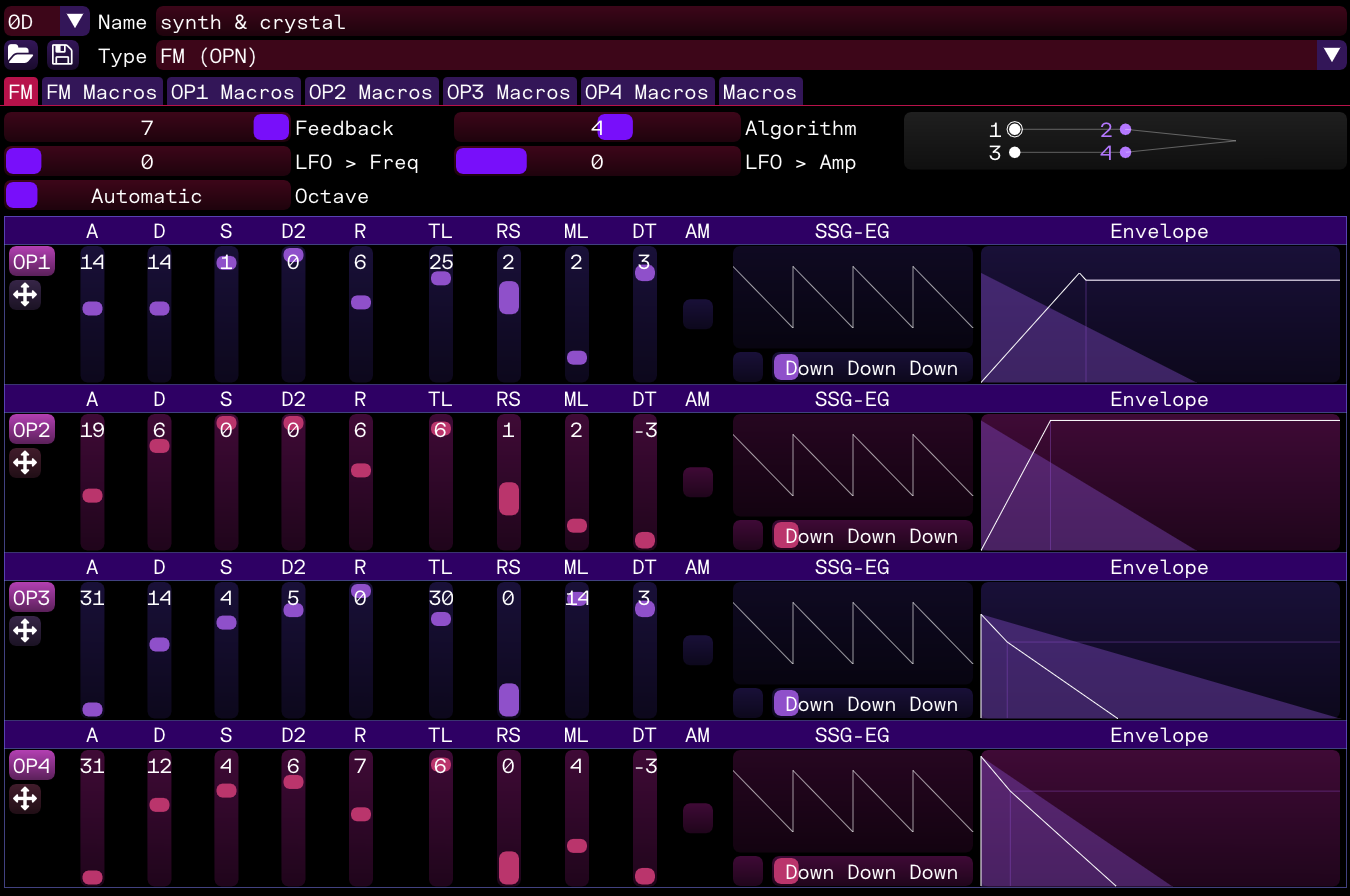
A very useful instrument
There is a quieter, calmer section which features a softer bass, the acoustic piano from Streets of Rage as rhythm, and the electric piano from YU-NO (PC-98, OPNA) handling the lead melody. Once again, talk about the best of both worlds! I think this is where it starts to become apparent that even though I aimed for a similar mood to Tsukumo's original, I got there by different means, and that's a good thing--it's not merely a faithful cover; it has my signature sound all over it. Incidentally, the square waves normally handle harp-like glissandi and echo. We also have orchestra hits originally from Sunsoft's Batman, modified by Molkirill and further tweaked by me, being used to accent some key moments. In the chorus, the melody is handled by my "trumpet synth". I call it so because it was originally a trumpet instrument (probably included with Furnace) which I modified to sound brighter and sharper; more like what you'd get in a "sawtooth lead" from some random General MIDI soundfont--even though the waveform looks nothing like a sawtooth. It sounds pretty good either way, and in the final part, it's harmonized with the square waves. This gives that specific part a very S.S.H. flavor.
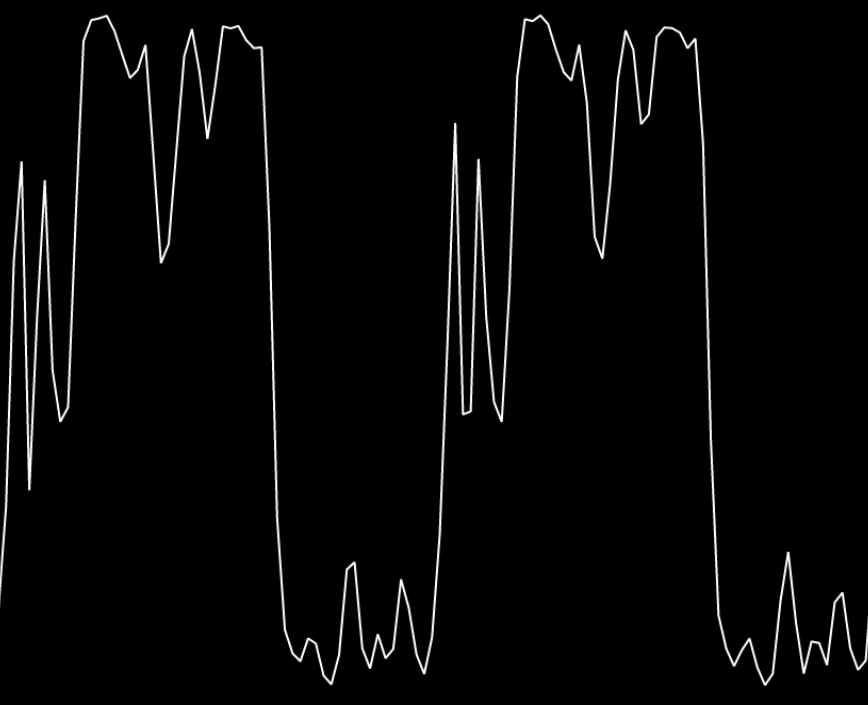
"Trumpet synth"
That concludes the first "loop" of this piece. Then the metal section begins: the synth strings are replaced by my custom, further tweaked rhythm guitar (we're at version 5 at this point), and my Orwell Lead guitar instrument becomes the main focus. I restrained myself with the pitch effects before, but here I fully unleash them upon the patterns, with tons of pitch slides, vibrato and portamento. I think it works better because if I had abused them throughout the entire arrangement, they would be less impactful. There are fewer instruments here, so I can have channel FM 5 doing out-of-tune echo for the lead guitar, and the square waves can focus on the glissandi. By having both squares play the same notes while also being set to be out-of-tune with each other, an interesting echo-y effect is achieved. It wasn't really necessary, but I don't like to leave free channels empty.
The quieter part, this time, uses a steel guitar--I thought it'd be quite appropriate to use another type of the same kind of instrument. For the rest of the "loop", though, I rely mainly on the trumpet synth and lead guitar. There is an extra chorus at the end where all the melodic instruments are shifted up by one semitone, and the drumming is more aggressive, with double kicks and more intense fills--nothing too extreme, though.
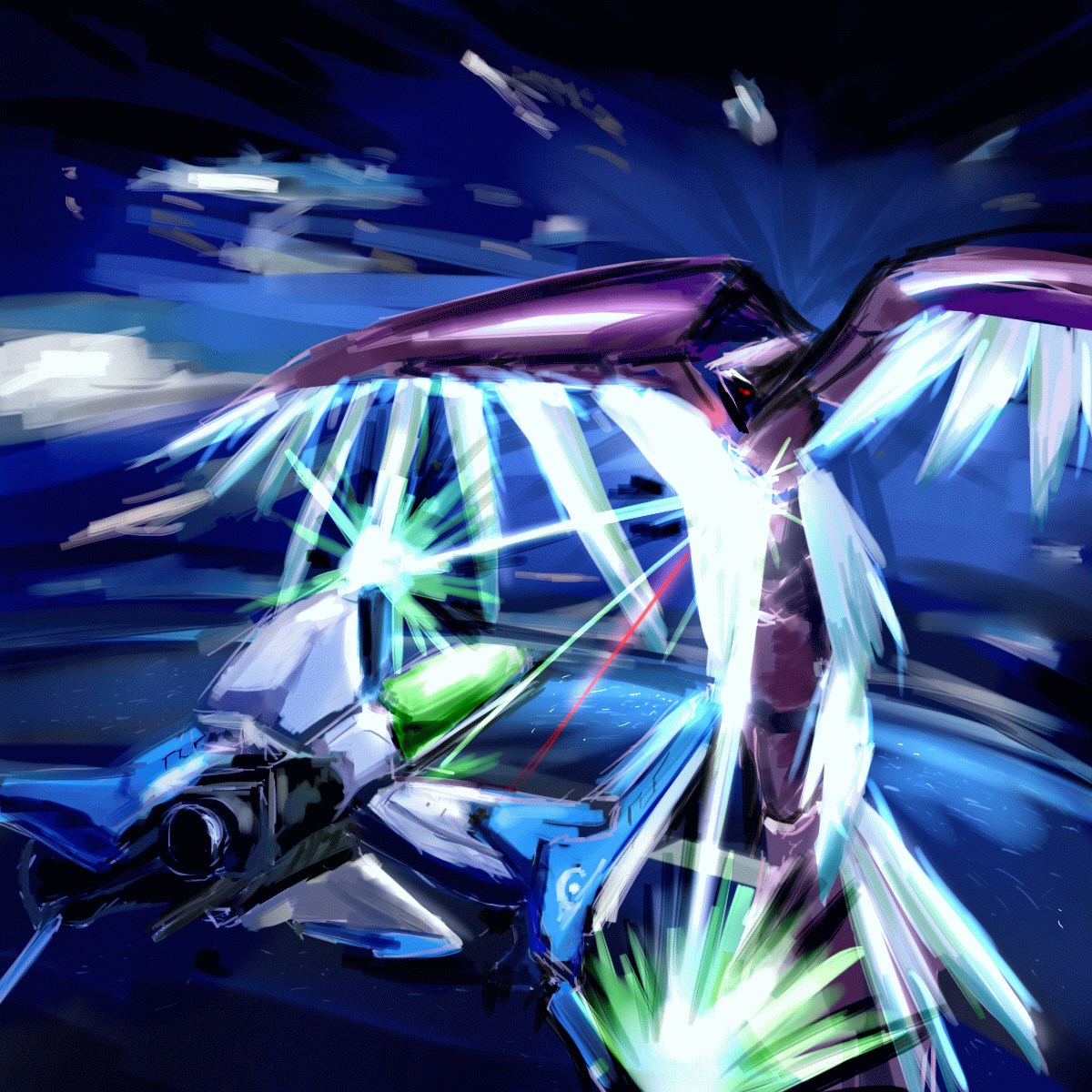
Artwork of the level boss--just for variety
Now, the drum samples are mostly from the Arachno Soundfont (big surprise there), but the power snare is not. It's from the Timbres of Heaven soundfont, and I decided on it because it sounds less aggressive--again, I was going for something a little less extreme than what I did to Metal Squad. Of course, that meant I had to create the composite samples anew, which was somewhat annoying, but it had to be done. Kick + crash, snare + crash, snare + 4 kicks, etc. Here's the interesting part about my samples: at some point, I actually incorporated PCM orchestra hits. I extracted the sample from the MT-32, tuned it, added two "Generic PCM DAC" channels to lay some notes, recorded those, and mixed them with kick + crash samples, later to remove the extra PCM muscle. So, I had some huge composite samples, containing several orchestra notes, playing on the YM2612's PCM channel. However, I ended up removing those because even though they sounded very realistic, I felt they were distracting, they were taking away from the quality of the FM instruments, which is very high already. This happens often: FM instruments sound synthetic by nature, and while using samples for drums is fine, using them for melodic instruments creates an uncomfortable dissonance. Not to mention they were huge as well.
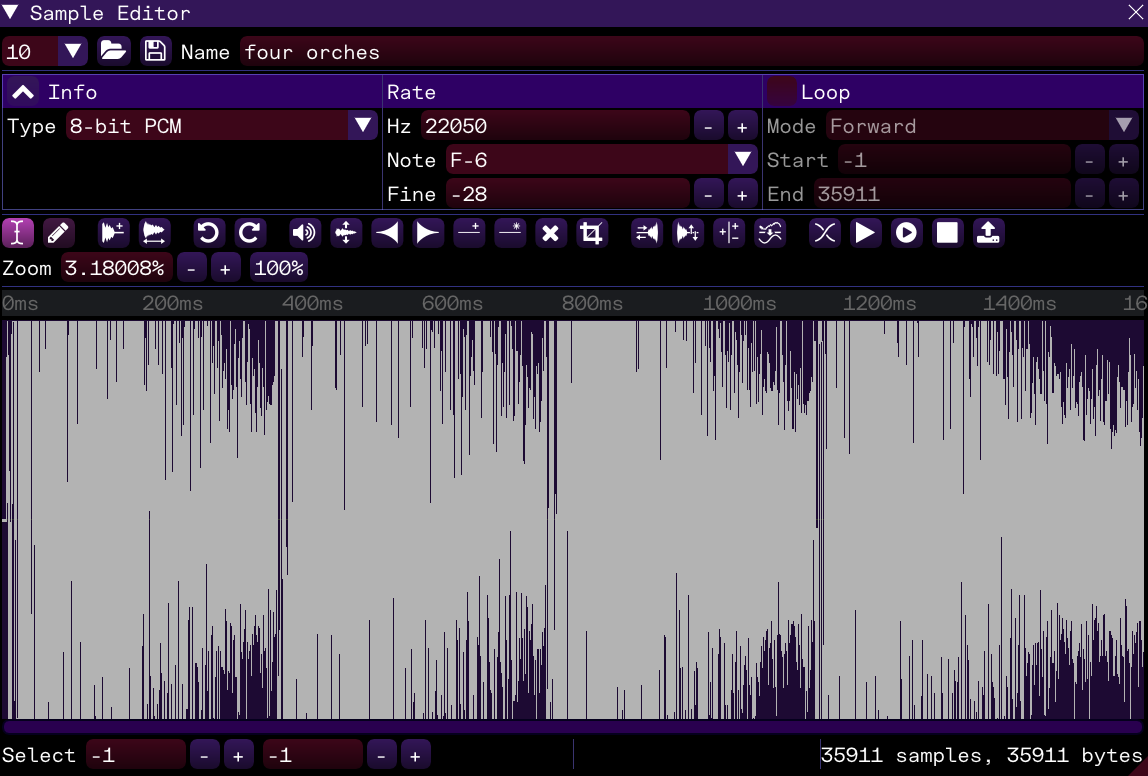
Excessive
So, that is my take on Legendary Wings from Thunder Force V. I should mention that while I was considering arranging other songs, I finally decided on this one because of this piece of artwork, which I have used as the video background. Just like the song, it captures the feeling of flying freely and heroically--Legendary Wings, indeed.

See you around.
Back to the index