Thunder Force IV ~ Metal Squad (S.S.H. Version)
for YM2612 + SN76489
By MetallicOrwell
This day was destined to come.
As a chiptune artist with a focus on the Sega Mega Drive and a specialty in heavy metal, there was no way I wouldn't attempt this song--it would have been blasphemous of me to ignore the majesty of Metal Squad from Thunder Force IV. I did not decide to tackle this now for any particular reason--perhaps the metal gods themselves decided to strike me with their lightning at the beginning of the year. They are whimsical beings, you see. Regardless, it was the appropriate time, because after doing a dozen or so metal songs on this console, I now have all the experience and skills needed to make the Mega Drive scream heavy metal like it's on fire and every single extinguisher on the planet has been confiscated. But so many talented people have done excellent versions of this song on this console already (including Molkirill, of course)! I knew that if I was going to do this, the result had to be, hands down, the greatest, craziest take on Metal Squad ever heard on Sega hardware--not according to anyone's opinion but my own. This is my standard and no one else's.
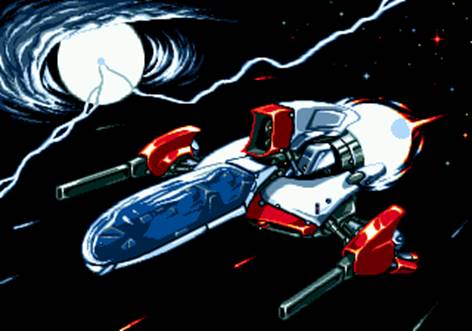
Fire LEO-04 "Rynex"
To borrow a term from the zoomer vernacular... I think I cooked.
The ace up my sleeve here is that I have access to the guts of Saitama Saisyu Heiki's old arrangements of Metal Squad from the early 2000s (so do you, really--the raw MIDI files are not that hard to find). That's right: I didn't base this on the Mega Drive version of the song, but on S.S.H.'s, and that's my key advantage here. Our old boy from Saitama, in turn, based his arrangement on that of one "DEARNA", another Japanese arranger from the same time period who is thankfully not as obscure as poor Kamino-san. And of course, if we're talking about inspiration, we can't forget that Toshiharu Yamanishi ripped off Soldier of Fortune by Loudness when creating Metal Squad in the first place. So we have another chain of causality: the original song in 1989, then Yamanishi's "homage" in 1992, DEARNA's take whenever that happened, then S.S.H.'s first version by the end of 2000, a newer improved version he did in the summer of 2001 (right after Venus Fire), and then mine right at the beginning of 2026, bringing it all the way back to the Mega Drive. It's like I'm a VGM historian or something. Regardless--this is NOT a MIDI file being played on a "soundfont". It is a Furnace tracker sequence that will play on real Mega Drive / Genesis hardware, and I transcribed/copied and tweaked every single note myself, one by one--no cheating.
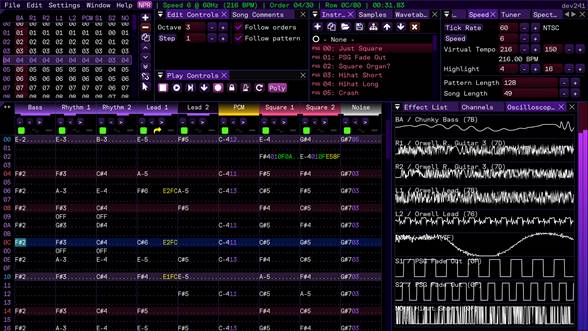
Furnace tracker
I kept listening to S.S.H.'s final MP3 render of this arrangement and kept thinking to myself: "as incredible as this is, it's missing something, it's being held back from true greatness--why?" I realized it was two things. Firstly, he did away with the intro riff, replacing it with something else. Bold move, but I don't think it was the right one--you just can't have Metal Squad without the initial riff that just crushes your skull. The second problem (which is far more important) is that the whole mix is too focused on the high-end. The lead instruments and the drums are too high pitched, and the rhythm guitar isn't loud and heavy enough. Metal Squad is all about that rhythm guitar: in the Mega Drive version, it overpowers the entire mix, and in fact you can barely hear the FM drums. I think there's a bass guitar in there somewhere, too, but good luck finding it. I do understand that this was just S.S.H.'s style at the time, but even he realized the same things I've said here, because in a more recent take on this song from 2012 (Blast From the Past) he made the exact changes I've said are needed. He even included an original solo in the beginning, as well as the intro from Lightning Strikes Again--way to go above and beyond. Ah, yes... before metal arranges of video game songs were popularized in the 2010s by youtubers, there was Saitama Saisyu Heiki--the OG VGM headbanger himself. And he was still a teenager when he did this arrangement! Jesus...
S.S.H.'s old website banner
Anyhow: I built this on top of the project file for Venus Fire, which itself was built on the one from Fire Field (it's all one grand tapestry, isn't it?). I figured I might as well make the process a little easier for myself, since transcribing and arranging a 6-minute long piece with 16.624 notes at 216bpm isn't exactly a day's work in the first place. The workflow was quite different, however. With Venus Fire, I transcribed the whole thing first and polished it later. In this case, I combined both approaches: I'd transcribe around 8 bars (again, by hand, note by note), polish that, and then move on. It made the process much more enjoyable and so it felt like much less of a sacrifice. In fact, it was quite a joyous thing, like watching your own child grow up or something... until the kid turns out to be a little terrorist and you're a bit shaken by what you've created.
Now that the preamble is done, let's move on to the specifics of the process!
My formula for heavy metal on the Mega Drive hasn't changed because it works: the rhythm section includes a loud, distorted bass in FM channel 1 (typically Chunky or Electric) as well as twin rhythm guitars in FM 2 and FM 3 panned to each side. I've listened to a lot of metal in my time, and you *always* want two rhythm guitars--even bands with a single guitar player, like early Overkill or Nevermore, typically lay two rhythm tracks in their studio recordings. FM 4 and FM 5 are for the leads: sometimes harmonized, sometimes with out-of tune echo. If I can get away with it, though, they can also handle extra rhythm duties. FM 6 handles PCM drums: for a while now I've been using samples from the Arachno Soundfont, as it has the best old-school power drums I've heard (sorry, Roland SC-55). The first two square waves of the SN76489 are used for support (anything that doesn't fit in the YM2612's limited channel count), and the noise channel handles hi-hats and crash cymbal backup. This formula is balanced, effective, and it streamlines the whole process nicely.
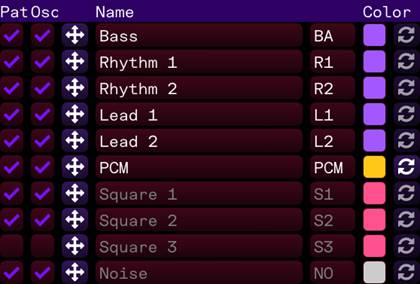
The formula
Now, in order to discuss the intro riff, I need to explain Thunder Force IV's sound design in detail. Its rhythm guitars are legendary, and there are two distinct ones: the one that is used in the intro and boss themes, and the one from Metal Squad. In the intro, it's achieved using two instruments: a sharp, almost robotic-like guitar, and a thicker, lower synth-y sound. There's also another channel for echo. This way, the high and low end are covered, and you can do this if the song is only rhythm guitar, bass and drums--you have plenty of free channels. In Metal Squad, the guitar tone is completely different, because there are more instruments, so it had to be done with fewer channels.
So for the intro riff in my version, I had to experiment a lot to get it right. In the end, it uses four channels: FM 2 and FM 3 use my custom Orwell R. Guitar with just a little bit of tweaking to shave off the high end and make it fatter (it's amazing what can be achieved by just changing the sustain level of the first operator by one digit). Again, they are panned to each side. FM 4 uses the exact same thick synth-y instrument from TFIV's intro I was talking about, and FM 5 uses Molkirill's rhythm guitar. Combined, they form a Megatron of guitar heaviness that might just be the best ever on the console. This can't be maintained for the rest of the song though, since of course there is a lot more than just rhythm guitar, so when the song proper begins, I use my standard formula I mentioned before with only two rhythm guitar tracks--my custom ones. Incidentally, the intro right at the beginning with the Sonic 1 Ring, Harpsichord (random-ass patch I got somewhere) and FM noise for reverse cymbal creates tension, so when it explodes into the riff, you really feel the impact.
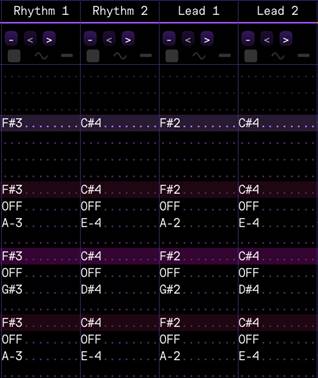
The four channels
The rest of the process, however, was quite similar to that of Venus Fire--I would recommend listening to that arrangement as well as reading its accompanying readme, as it provides more context for this one. Once again, I decided to use the second lead channel for out-of-tune echo, which creates a massive sound when combined with the reverb-heavy drums. S.S.H. mainly relies on a lead guitar and a lead sawtooth synth, and those often take turns occupying FM 4 and 5 in my arrangement, although sometimes the synth is moved over to the square waves, which works nicely, as you'd expect. There's a pipe organ which is used occasionally on the YM2612, but usually its notes are moved over to the PSG. In general, though, there is a lower variety of instruments when compared to Venus Fire.
One thing of note: although this piece is based on S.S.H.'s finalized 2001 version, there are some sections which I borrowed from his earlier 2000 version, such as the previously mentioned intro riff, as well as two solos which were sadly deleted. I was able to fit them back in there, and the arrangement is better for it. Compositionally, I don't think this take on Metal Squad is quite as spectacular as the Venus Fire one, but that only meant I was determined to make up for that with my trademark intensity. Of course there are lots of pitch slides, vibrato and portamento, especially on the lead guitar and lead synth. But the key element which sometimes pushes this arrangement into madhouse territory is the drums.
The Arachno Soundfont power drums strike again, like I said, but this time we have the return of the dreaded "snare + crash + 4 kicks" monstrosity which I hadn't used since Live & Learn, as well as a new "crash + 4 kicks" composite sample. There are quite a few of those, EQ'd for enhanced treble to make up for the loss of quality when adapted to the YM2612's limits. They are what allows me to inject Metal Squad with carefully controlled doses of what is essentially extreme metal drumming. Not a single pattern is spared--I included constant fills to complement the rhythm and melody everywhere. I'd like to think I struck a balance between augmenting the aggression and maintaining the beat in a coherent manner. There are moments when it IS too much--but then it goes right back to the main beat. I think those calculated moments of excess work quite well. All in moderation, right?
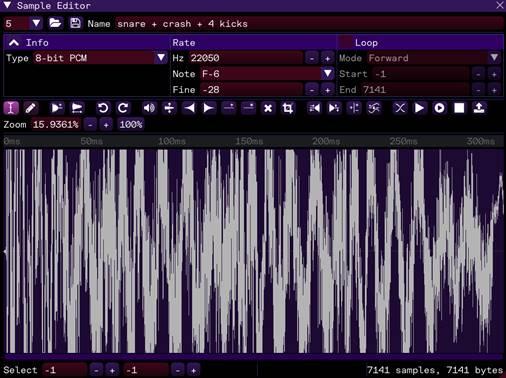
The monstrosity
And yeah, this thing goes on and on, combining recognizable parts from the Mega Drive version of Metal Squad with S.S.H.'s own flavor and solos, then FM'fied and further metalized by me. The chorus anchors it all and gives the song a recognizable structure: it is used a total of three times, each longer than the last, and the final time there are key changes to make it even more exciting--that's what S.S.H. did, anyway. I thought the final chorus went on too long and was just slightly redundant, so I've made it more interesting by making the rhythm guitar and drumming get progressively more extreme, until at the very end it's basically DragonForce territory. Someone should really stop me before I commit even worse war crimes, but no one will. I'm not sure anyone really can at this point.
Overall, even though the hardware (stock SEGA Mega Drive) is infinitely more modest than S.S.H.'s monster Yamaha MIDI modules, the result is even more intense because of the raw edge of FM synthesis and PSG square waves, which makes this piece feel closer to the 1992 version while at the same time incorporating all the key elements from S.S.H.'s uncompromising, maximalist arrangements. Sometimes less is more, and sometimes MORE is more, and this arrangement proves both things can be true at the same time. And then there's me--this has my signature sound all over it, and I'm not gonna pretend I didn't do an amazing job with it. I'm standing on the shoulders of giants, though. I should never forget that.
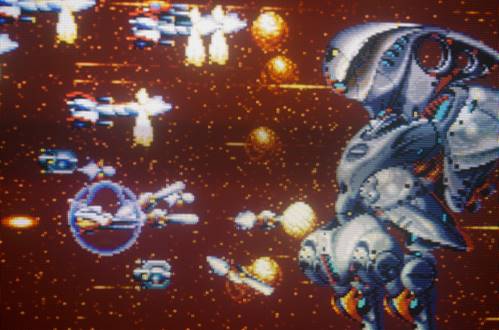
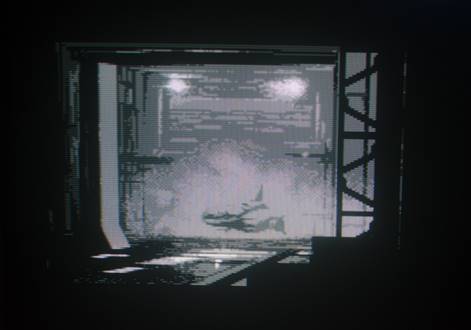
Thunder Force IV being played on real hardware on a CRT
I'd like to close this dissertation with a quote from S.S.H.'s readme from 2001: "please try not to bang your head too hard and hit something (laughs)". Actually, fuck that. BANG YOUR HEAD AGAINST THE STAGE AND METAL TAKES ITS PRICE.
See you around.