Thunder Force III ~ Back to the Fire [Metallic Mix]
for YM2612 + SN76489
by MetallicOrwell
It's time to show Thunder Force III some more love. I've done quite a bit of Thunder Force stuff already, mostly improved Saitama Saisyu Heiki covers, but this time it's all me, just like when I did Steel Of Destiny. This is my first attempt at a somewhat more sophisticated kind of expansion: instead of just doing a faithful first part, second part with solos and finally the chorus in a higher key, like I did with Fullmetal Fighter from Musha Aleste, I analyzed the song section by section, expanding or modifying things in a way that I think feels less forced and more natural. There's just something about Thunder Force music that demands the very best I can do and nothing less. And also, there's the fact that after six expansions, a boring old cover wouldn't do. Let's do this thing.
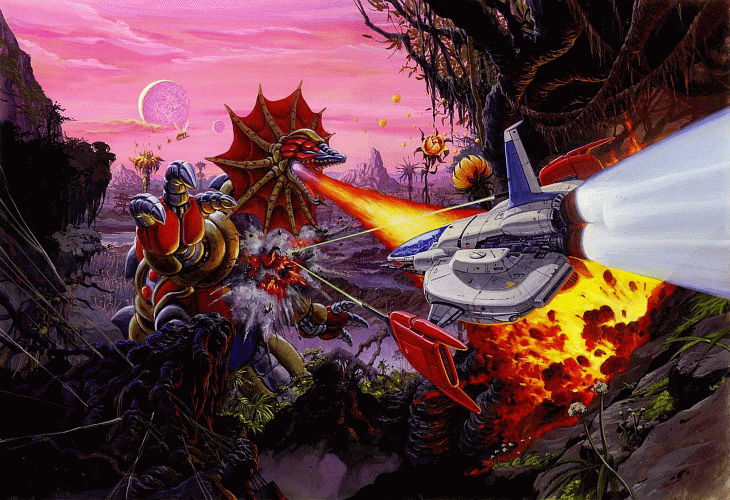
I began the process by studying the original 1990 version of Back To The Fire by Toshiharu Yamanishi. Interestingly, he allocated his channels like this: on the YM2612, one for the bass, two for the rhythm guitar, two for melodies, and one for drums. He basically figured out the "metal formula" 35 years before I did--go figure. The SN76489's square waves are used mostly for support, though sometimes they play lead melodies, and the noise channel goes unused. The quality of the FM instruments is about what you'd expect from a Japanese Mega Drive game from 1990, which is to say that they are okay, but they don't take advantage of the YM2612's true capabilities. Now, what's interesting is how the song is mixed. The kick drum is by far the most prominent instrument in the entire mix, and the rhythm guitar is so buried you could mute the channels and barely notice a difference. Very strange choices by Yamanishi here, but I'm not here to judge--I'm just here to run his baby through the metal forge.
So, because the approach I took was fundamentally different, that opened up a lot of possibilities. For example, I took the melody from the first verse of the original song and composed some accented drum hits, and then used that as the intro to the piece. It's followed by a more faithful version of the verse: it's a way to reuse and expand material in a way that feels natural and not too cheap. I didn't like the original rhythm guitar parts, so I composed my own. There's a small section with a quick guitar solo, and then we do the next verse again, first faithfully, and then one more time, but turning the melody into harmonized guitar leads. That's going to be a recurring theme, by the way. The pre-chorus and chorus follow the original song for the most part, and then the full "expansion" part really begins.
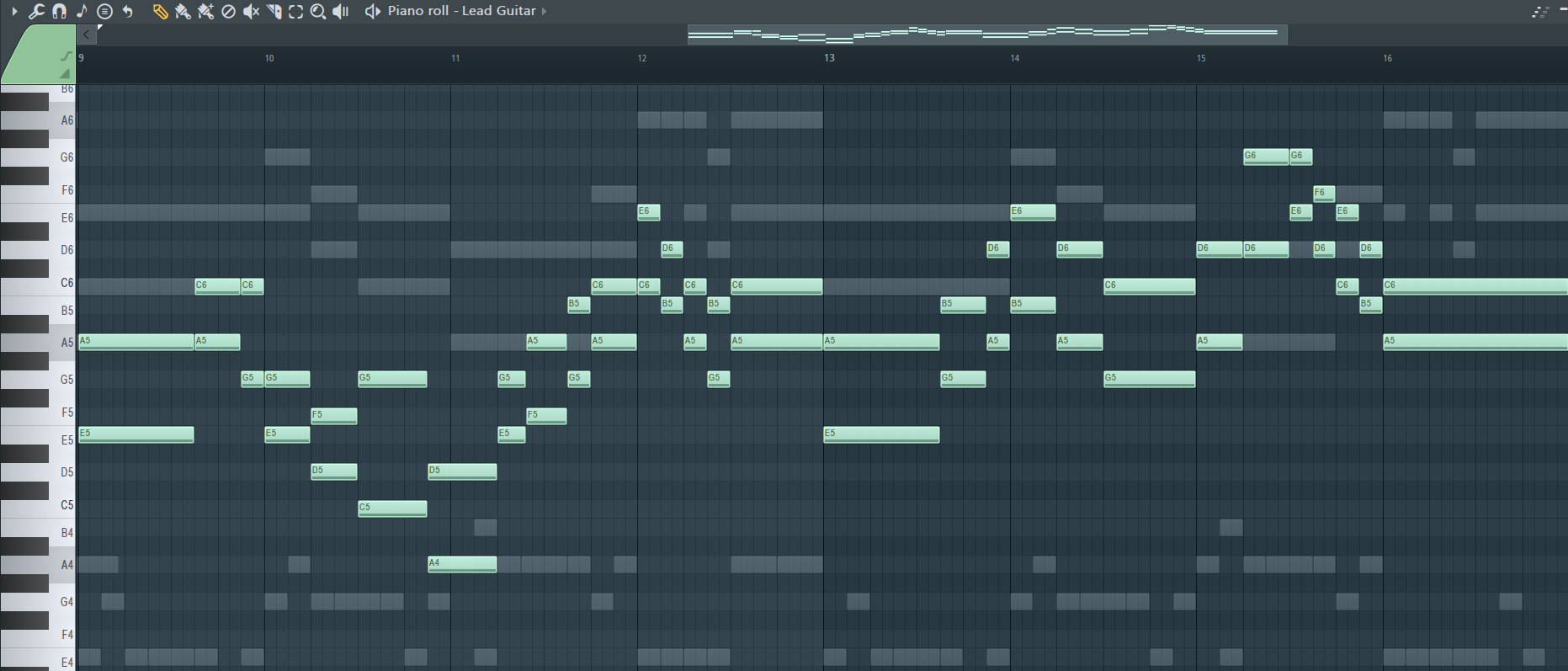
We repeat the intro with the accented drums, and then it's time for a guitar solo. We're reusing the bass, rhythm guitar and back-up square waves from the first verse, so it doesn't feel too out of place, even if the drums are in double time instead of straight time for the first two bars. For the next part, though, I composed the rhythm section from scratch, and also added some arpeggios based on some chords I came up with to fill out the sound. It's probably the simplest part in the song, but it helps to bring the focus to the guitar harmonies (which are based on the square waves from previous verses, so they are actually Yamanishi's). Yeah, there is a lot of Iron Maiden worship in this arrangement, but if you clicked on a MetallicOrwell piece and you weren't expecting guitar solos and harmonies, I don't know what to tell you.
After that, we return to the original song's pre-chorus, but the first part of it is made twice as long by modifying the lead melody a little bit, and the second part includes a quick keyboard solo. Again, I think this approach results in something much more creative and natural than just "faithful loop, loop with guitar solos, chorus again in a higher key, the end". When it's time for the chorus, the lead melody is harmonized (obviously) and the drums are played in straight-time for an almost punk rock-ish (?) feel. There's also a quick solo. Then there are a couple of callbacks, and the piece ends.
All of this took place on FL Studio, of course, because a good piano roll is a million times more convenient for composing than a tracker grid. But of course that's just the MIDI sketch and not the final product, which is always a Furnace tracker sequence. It was time to copy the notes manually and design the sound for the Mega Drive.

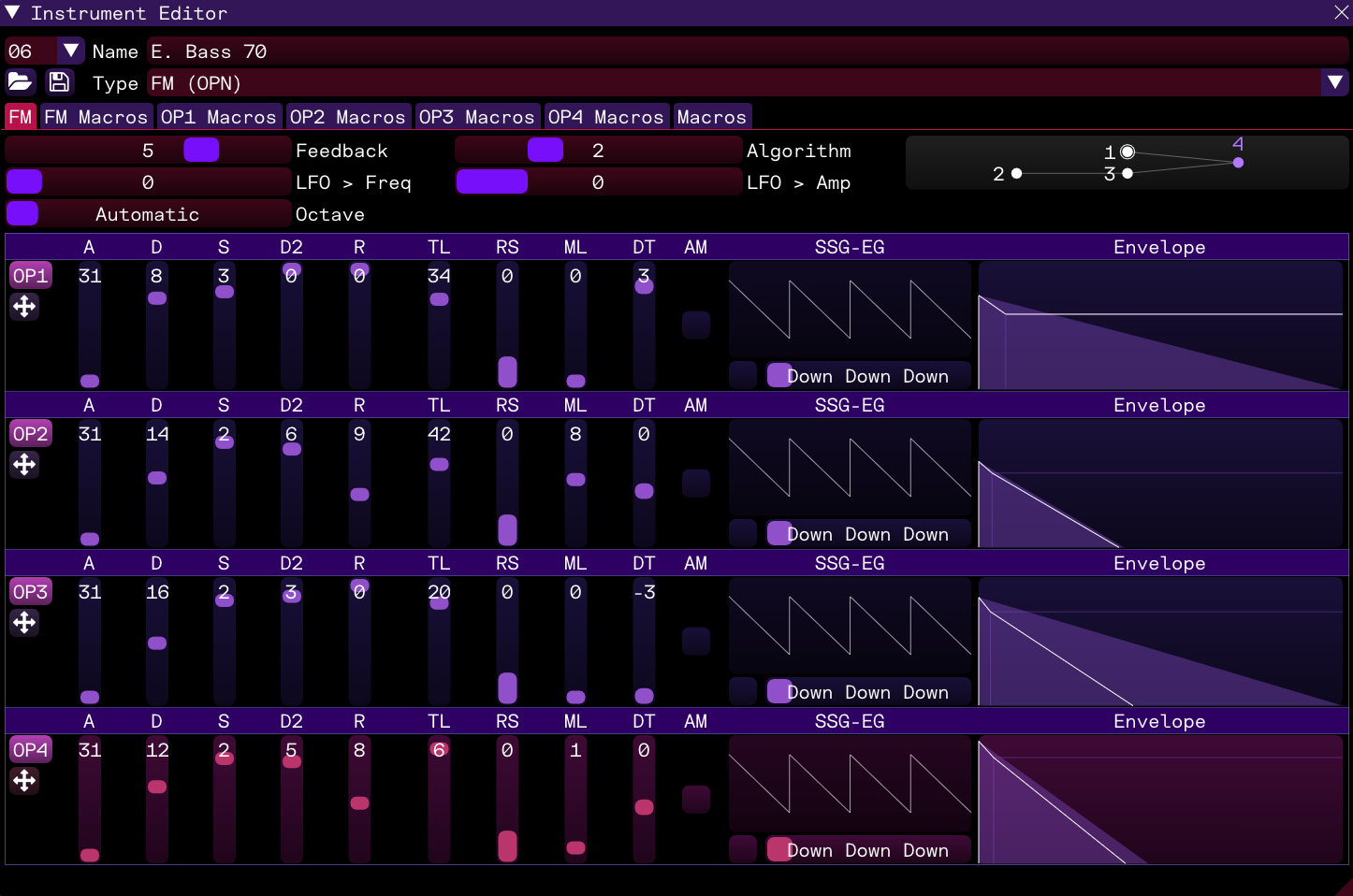
Like I said, Yamanishi figured out the perfect formula for metal way back in the day, so why mess with it when I discovered the same thing on my own a while back? FM 1 for bass, FM 2 and 3 for panned rhythm guitars, FM 4 and 5 for leads, FM 6 for PCM drums, square waves for support and noise channel for hi-hats. The bass is chunky as always, of course, but let's geek out over it a little bit more. The instrument is called E. Bass 70, and for some reason I thought it had come included with Furnace, but that was wrong (it's been a while since I discovered it, so I misremembered). It was actually part of a huge pack of instruments I downloaded when I was starting out, and it looked like it was originally from a program called TFM Music Maker, which is an FM tracker from the late 2000s. In fact, I downloaded the program out of curiosity, and there was the E. Bass 70 preset, with a modification date of the year 2004. However, it was inside a folder called "mvstrackermd", which would mean the instrument originally came from yet another, even older tracker called (you guessed it) MVS Tracker MD--which I also downloaded, and sure enough, there was my favorite FM bass ever yet again. Now that's some epic lore right there. I wonder if it was made by the tracker's author, a contributor, or maybe its history reaches even further back into the 90s? Could it have been originally ripped from a commercial game? The .vgm format was created in 2001, so it might have been possible...
I am, in fact, a gigantic fucking nerd and this was quite the digression. Let's get back on topic.
The rhythm guitar, lead synths, electric piano, strings and so on are all instruments I've used before. The drum samples are a mishmash: the kick and crash cymbals are from the Arachno Soundfont, the snare is the one I yoinked from an X Japan song before for The Metallic Maiden, and the toms are the lower ones from the Yamaha MU-2000 EX's power kit, just pitched up slightly. They sound quite potent, so I like them a lot. Other than that, it was mostly business as usual at the Orwellian Metal Forge. I played around with the tempo a little bit: the original version of Back to the Fire runs at 186bpm (quite fast), but when I made the sketch I originally set the tempo to 170. I bumped it up to 175 when I first copied the notes over to Furnace, and finally to 180 when I decided on the X Japan power snare over the Arachno Soundfont one. The more overpowering the snare is, the muddier the whole thing sounds, so slowing it down spaces out the drum hits and lets them breathe a bit. But the X Japan snare is tight, so 180 was no problem.
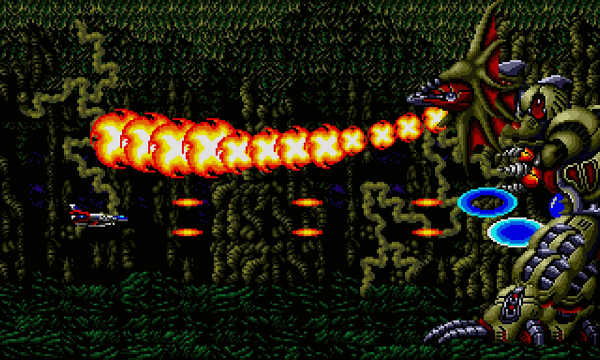
I think this one has turned out quite excellent, and yet part of me wonders if the trip to the forge was the right move at all. Yamanishi's original version has a "cute" sound, for lack of a better word. Obviously, nowadays the "Thunder Force = heavy metal" association is inescapable, but I don't think it existed in 1990 yet. If I'd made this sound more like my Star Cruiser cover, for example, it might have turned out equally fantastic in a completely different way. Oh well, it is what it is. I've been thinking about also covering / expanding the level 3 theme (The Grubbly Dark Blue), and that one would definitely benefit from a different sound, perhaps similar to my Sky Sanctuary cover from Sonic & Knuckles, or again, Star Cruiser's main theme. We'll see.
See you around.
Back to the index