Final Fantasy NES Trilogy Battle Medley
for SPC700 / S-DSP
by MetallicOrwell
November of last year was a very productive month for me. That was when I did a medley of the battle themes from the Final Fantasy games on the SNES, first for the Master System and then an expanded version for the Mega Drive. For a while now I've been toying with the idea of doing something similar, but for the battle themes from the NES / Famicom FF games. Well, here it is. This time it's for the Super Nintendo, however. I feel like the Mega Drive is getting the cuck chair increasingly often these days, and I'm not sure how I feel about that. Well, nothing is stopping me from adapting this to FM synthesis later, but for now let's head over to sample land. Also, in this write-up I will be referring to the battle theme from Final Fantasy I as FF1, the one from Final Fantasy II as FF2, and so on. It might seem a little awkward at first, but I think it will improve readability. Let's get into it.
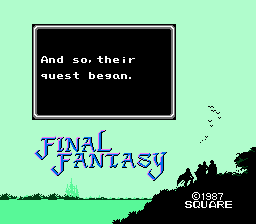
I based this on the project file from The Aeolian Battle, so once again the samples are all from Final Fantasy IV and VI, except for the tom drum, which is from Chrono Trigger. This made sense because the idea was to make this medley sound very close to Nobuo Uematsu's style during the early SNES era, and the samples he used were a big part of that. His composing style had evolved a lot by then, however, and I was surprised to find out that, in a way, the NES battle themes could be quite daring and experimental.
After listening to all three themes a few times, I decided on an order that works for this medley: I placed them in reverse. Here's why: FF3 sounds catchy and energetic (similar to FF4), FF2 sounds catchy in the beginning but sounds like a horror movie in the second half (I told you Uematsu was daring), and FF1 sounds both catchy and scary at the same time. By placing them like this, you get a coherent, evolving mood that goes smoothly from catchy to scary and back to catchy again, because the whole medley loops. I apologize for repeating the word CATCHY so much--I think I'm done with it. Incidentally, all three songs originally ran at slightly different speeds, but here I set the entire thing to 150bpm for consistency.
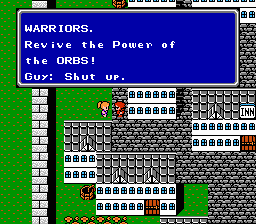
I used the original, basic NES / Famicom themes as a base. There have been a million remixes and arrangements of all kinds of Final Fantasy music, and of course the entire Final Fantasy III OST was redone for the DS (and let's not forget the pixel remasters...oh God). I didn't want to be influenced by anyone else's takes on these pieces; I wanted to use my own compositional abilities to expand upon them. So, what are we working with here? None of the three songs use the Famicom Disk System or any of those fancy audio chips that are so popular, like the Konami VRC7: it's all just the old Ricoh 2A03. Also, only FF3 uses the noise channel for percussion--the other two were composed without any drums in mind. Now that's an interesting challenge as well as an opportunity: composing drum patterns for music that wasn't meant to have drums. For the most part, though, my focus was on the two pulse channels, which handle the melodies, and the triangle channel, which is for the bass. My plan was to turn the main melody into two harmonized trumpets, make the secondary melody into a harp, and add original backing strings. The basslines need no explanation, I should think.
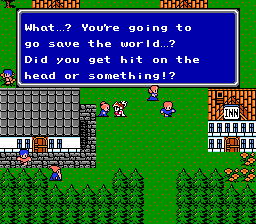
FF2 and FF3 are in A minor, whereas FF1 is in G minor... mostly. Of course the great Nobuo Uematsu wouldn't be constrained by something silly like scales or keys, which only complicated things for me. Creating a harmony isn't as simple as just playing the same melody two steps apart up or down, especially when there are notes which are not part of the scale the song is supposed to be on. So that was quite the headache, in particular during the "horror movie" parts of FF2, because it's supposed to sound dissonant, I think. I may not yet be able to tell what note I'm hearing just by listening to it (I'd say that's an advanced skill for a musician to have) but still, my ears are quite sensitive to dissonance, and in general to when something just doesn't sound right in a piece of music. Getting FF2 to sound acceptable to me was difficult. And then there are the backing strings: sometimes they play the same notes as the trumpets, and sometimes they play something different. It's all about experimenting in the piano roll (I did most of the composing on FL Studio, as usual), and I'd say they were the hardest thing to get right. There's even a section in FF1 where they swap roles with the trumpets because it just worked better that way.
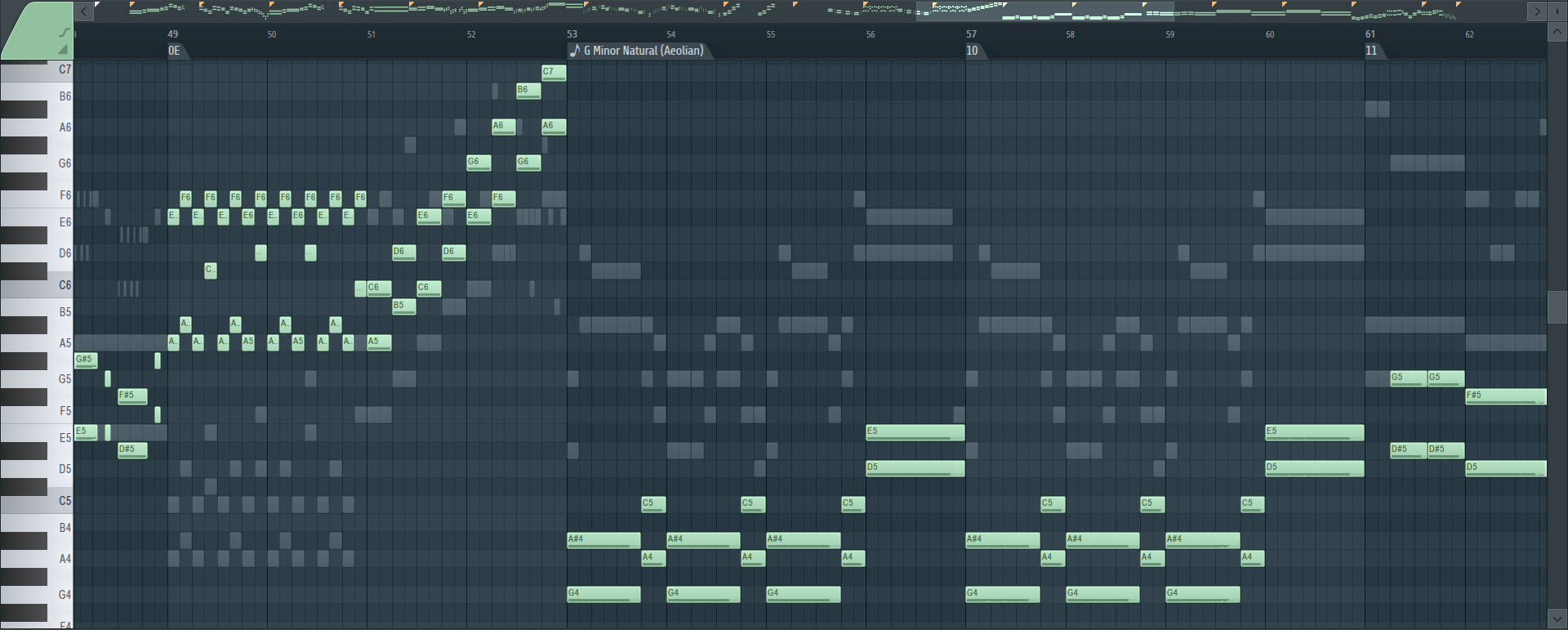
The harp was simple enough, but it still helped me to discover something really useful. Normally when using a tracker you'd double the tempo to have finer control over shorter notes, but I hate doing that and I'd rather not have to. There are other options though, and I discovered an unlikely one: the arpeggio effect. By setting its speed to half of the song's, you can use it to play two notes in a single row, and it works perfectly. It's not even a very convoluted technique, either: just set the number of semitones to whatever you need the second note to be in that specific row, and change it in the next. I will definitely be taking advantage of this discovery in future projects.
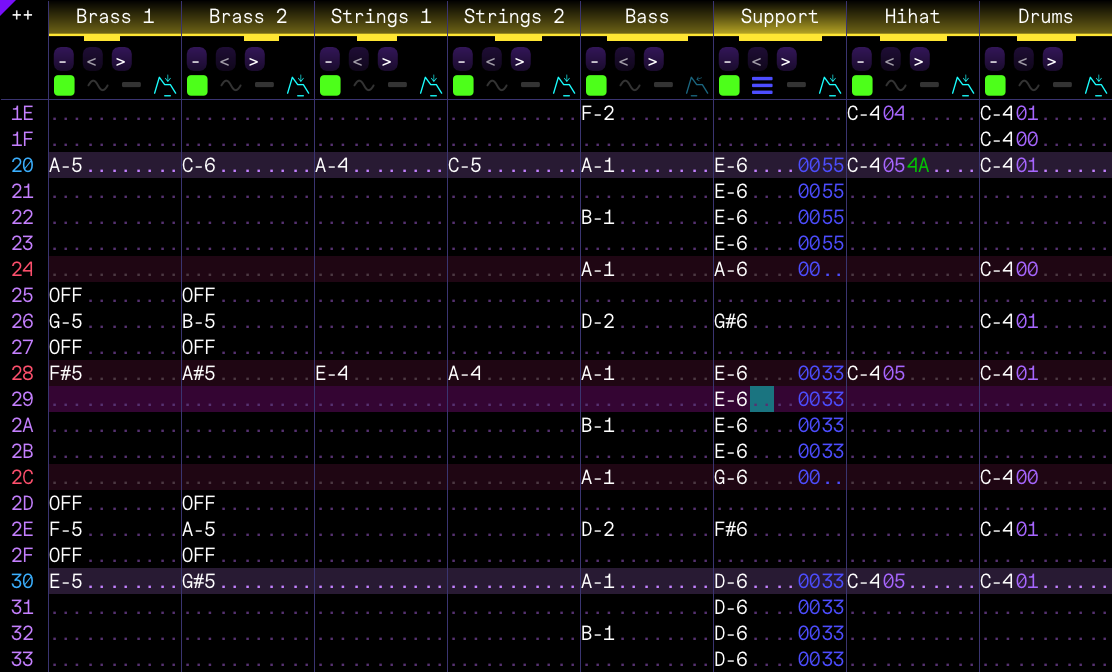
That leaves the drums, which were pretty damn fun to do. I followed FF3's fairly closely, but after that it was time to get weird. Again, FF2 and FF1 didn't originally have any drums, and so they were composed in a way that doesn't lend itself well to a typical, predictable kick -> snare pattern. FF2 in particular required me to get creative, and so I did just that. Of course I got a little carried away, because I love intense drumming with lots of variety and fills. I'd say it's just about as intense as you could reasonably make it without murdering the whole concept of staying true to Nobuo Uematsu's early SNES style.
That should be about it. This was pretty fun, as well as challenging in ways I wasn't expecting, and I definitely learned some things. There could've been a little more variety in the instruments, perhaps, but I think it works pretty well as it is.
See you around.
Back to the index