S.S.H. ~ Bloody Tears Again (Castlevania II)
for YM2612 + SN76489
by MetallicOrwell
Hello and welcome back--I was just about to begin worshipping at the altar of Saitama Saisyu Heiki again. Would you care to join me?
Bloody Tears Again is yet another masterful piece of video game music expansion by our boy from Saitama. He took a 29-second loop and expanded it into a four-and-a-half-minute monster which combines orchestral music, jazz and heavy metal, with so many nuances and nice touches everywhere that it's honestly a little baffling. I've been a fan of this piece for a very long time now, but like I've said before, you don't truly appreciate a piece of music until you take it apart and build it back up with your own hands. Talent is one thing, but how the hell did he have enough musical maturity to pull off something like this at such a young age? Keep in mind he was born in 1982 and Bloody Tears Again is from December of 2000, so he had to be 18 at the time. Naoto Shibata's version of Bloody Tears is comparable in quality, I think, but he was a veteran heavy metal musician by then (he was 36 when Perfect Selection Dracula Battle was released in 1994). I suppose there's being a genius... and then there's being Saitama Saisyu Heiki.
Interestingly, three versions of Bloody Tears Again were released in December of 2000 (that makes it sound professional, but it was really just one guy posting .lzh files on his website). One of them is the "botched" version, and it's only a minute long. It's got an NES-sounding intro, then it goes into power metal (as you'd expect from Senpai), but it ends pretty quickly. For whatever reason, he abandoned this attempt (took him only a couple of hours to do), which brings us to the second version of Bloody Tears Again. This one is much closer to the final product: the orchestral intro is identical, but it's missing the jazz part. I should mention that I know precisely fuck-all about jazz music, so I'm taking S.S.H.'s word here that it's supposed to be jazz. Other than that, the structure is more awkward and there's a lot more repetition--in fact, I'd say it feels rather bloated, even if it does have some interesting moments that were eliminated later. Finally, we have the "complete version", which my cover here is based on.
Normally, after talking a bit about the song I'm covering, I'd expound on how I did it technically. This time, I will be explaining how S.S.H. composed each part, and then I'll elaborate on how I adapted it to the Mega Drive instead--that'll probably make for a better flow. Let's do it.
Bloody Tears Again (Complete Edition) retains the intro riff from the original 1987 version, and in fact uses it many times throughout as a motif to anchor the whole thing and remind you that this is indeed Bloody Tears, despite all the crazy shit that S.S.H. added. It's used in the orchestral intro with some counterpoint to start things off, and then we have the melody from the original song's first verse, but modified and expanded, with harmony and harp accompaniments, as well as a french horn to add some bass. There's some percussion too, mainly timpani and crash cymbals. For this section, I used several variants of my custom Orwell Strings, often with note cut effects, and of course detuned echoes when I had free channels (pretty much only at the very beginning). The harp is by Molkirill, as is the timpani. The french horn is from one of the PC-98 Touhou games (modified by me), and the crash cymbals are done using PSG noise. The square wave channels are used to add echo to the main melody at first (since I had run out of FM channels), and later to do the harmonies with a vibrato effect.
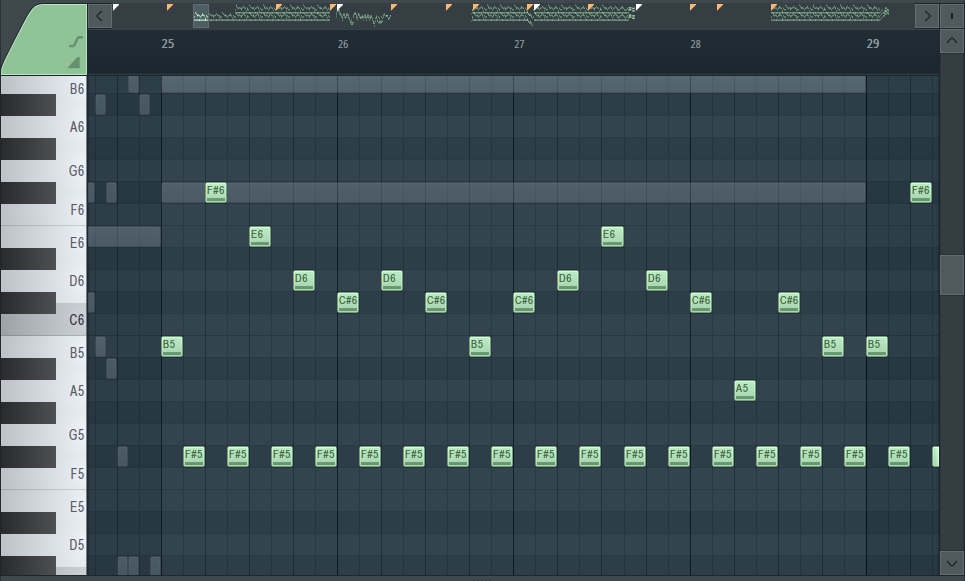
After that, we get into the song proper. This is much more recognizable S.S.H. fare, and we begin to see how clever he is. Bloody Tears Again is in B minor, and its main riff has a pedal point in the fifth, F#. It sounds very stable, so you can play it over and over with no variation while you change all the other elements of the song: the bass, guitar, drums, etc. The organ riff keeps the whole thing grounded in the spirit of the original song while Senpai is free to do whatever he wants with the rhythm section, and it works. First you get accented drum hits, as you'd expect, and then it changes into a more normal kick + snare pattern with some nice guitar riffs and bass flourishes. The chord progression descends from the root note every two bars before slowly climbing back up, which is very cool. In fact, a descending chord progression in a minor key with an organ riff on top of it is probably one of the coolest things in all of music, ever.
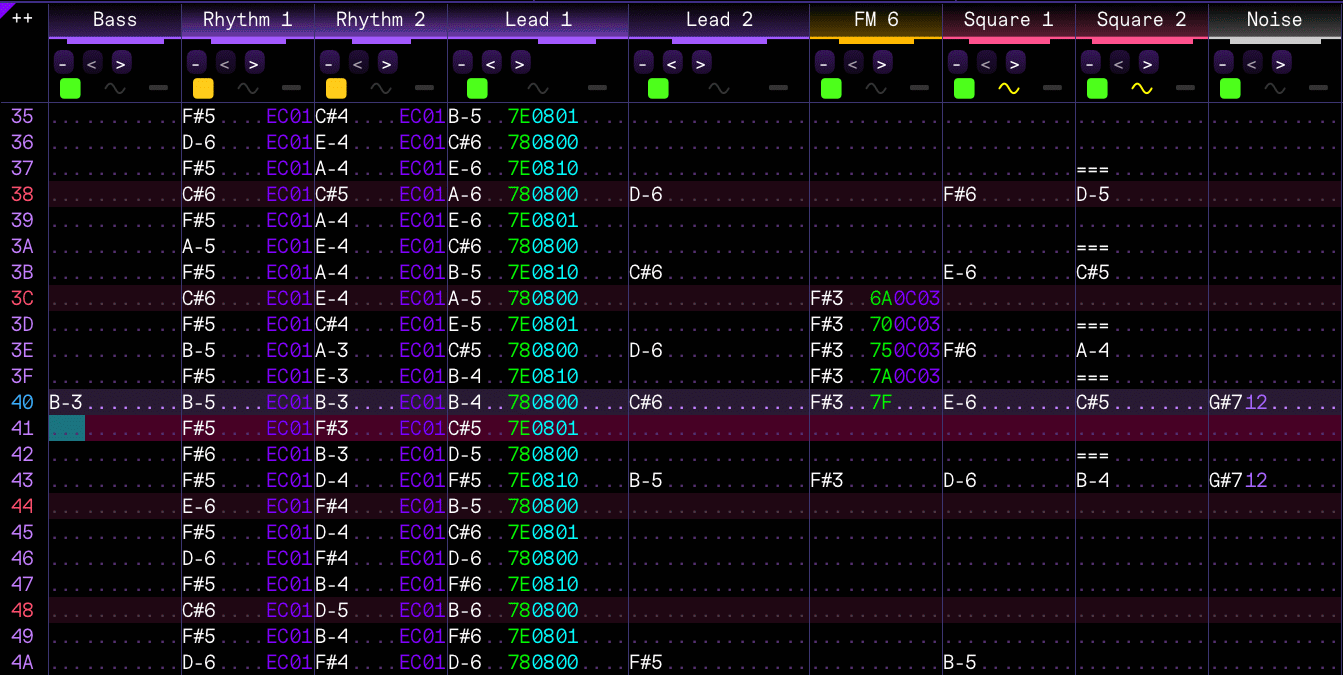
The church organ patch I'm using here was originally included with DefleMask, I think. The bass is, of course, the E. Bass 70 "Chunky" preset which, as far as I've been able to uncover, is from the MVS Tracker MD (2004). The rhythm guitars are mine, as is the lead guitar which is used to mimic the guitar trill with a legato effect. There's also one of the instruments that are part of the guitar from Thunder Force IV's intro, which I explained when I did Metal Squad almost half a year ago (Jesus Christ, time flies), and I used it to thicken my rhythm guitar in places. The drum samples? From the Arachno Soundfont, of course, except for the toms, which are from the Yamaha MU-2000 EX (how fitting). There are two composite samples: kick + crash, and snare + crash.
Now we get to the jazz (?) part. The melody from the original song's verse is played here on a brassy lead, and there are some backing strings, as well as a rock organ playing a solo. Because I'm not knowledgeable about jazz at all, I can't really explain much about the composition here, but I can say that it works very well because of the contrast. You get the power metal intro, then the jazz part, and then we go back to power metal. I used a different, fingered bass instrument here, as well as some Sakimoto brass from Master of Monsters. The organ patch used here is a different one, and it's also originally from DefleMask, I believe. The strings are mine as well.
The next section might be the most brilliant of all. It's power metal again, and it's based on the original song's chorus (you could also call it section C, I suppose). It's modified and expanded, of course, but we also have the *rhythm guitars* of all things doing counterpoint. Every time there's a sustained note in the melody, the guitars play a harmony, which is different every time. He even included some backing strings, but I couldn't fit all of that on my limited YM2612 + SN76489 setup, so instead I combined some of the strings' notes with the main melody. Again, the idea that a teenage kid was able to come up with all of this in less than 10 hours of work beggars belief. I decided to give this part a more orchestral feel by using modified orchestra hits from Sunsoft's Batman as well as my own strings again, and combined with the square waves, it sounds pretty fantastic.
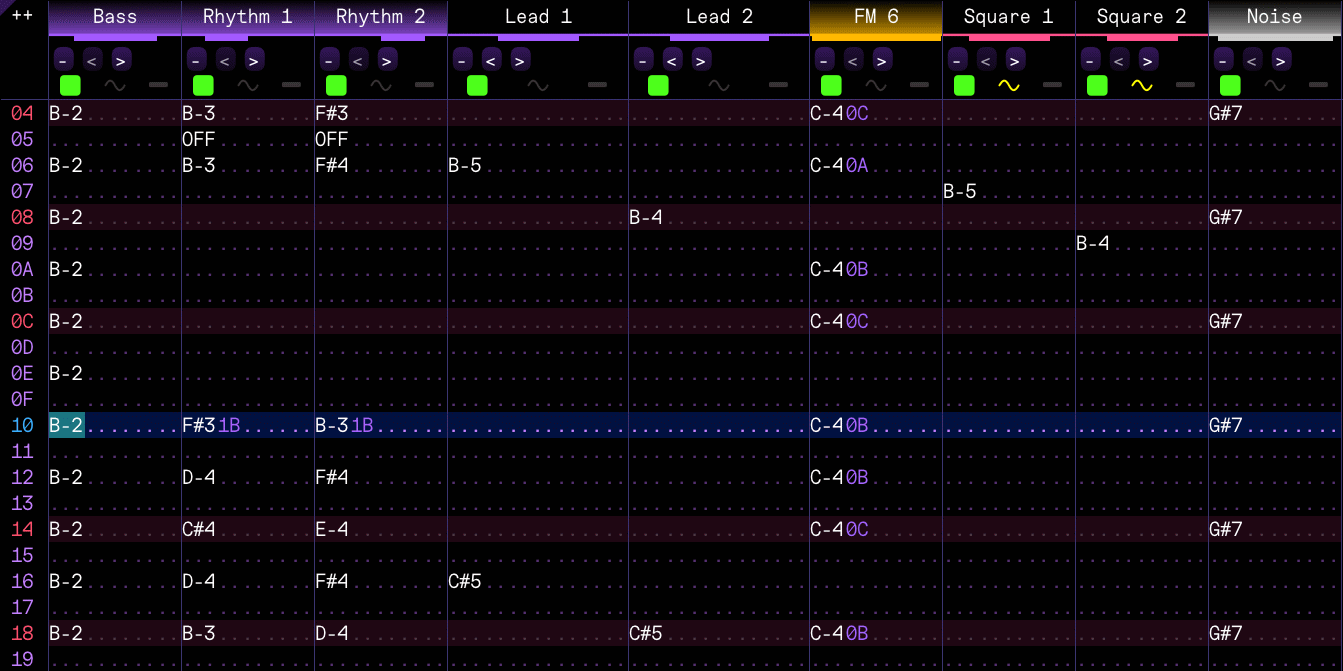
We get some accented drum hits again as well as stereo effects on the rhythm guitars, while the melody's sustained note goes up in pitch several times. I should mention also that I had to simplify the guitars a bit, because polyphony is at a premium on the Mega Drive, but S.S.H. tends to sequence two distinct rhythm tracks. Normally in metal you get two rhythm guitars panned to each side, but they're usually identical. Not in Bloody Tears Again: they're similar, but again, they have lots of nuances. The organ riff comes back, but rather than this next section being identical to what we got before the jazz part, the guitar riffs are different. Again, that pedal point riff is so useful because you could put anything under it and it would work.
Of course, this is a Saitama Saisyu Heiki song, so now it's time for a whole bunch of guitar and keyboard solos. They are varied, fantastic, they have triplets and harmonies with a synth lead and all the good stuff you could ever ask for. We then repeat a couple of previous sections for coherence, and we end the song with a bang.
I feel like I've been riding Senpai's dick pretty damn hard for the previous 1.5k words, but the more I listen to both his and my version of Bloody Tears Again, the more difficult it is for me to find any flaws in it at all--this is a brilliantly executed piece of music in every single aspect, and I'm glad I was able to do it justice. When it comes to taking simple, old video game music and expanding it, this might be his best work second only to Venus Fire--that one stands undefeated for me. And now, you get to enjoy it not on an expensive Yamaha MIDI module from the year 2000, but on your good old Sega Mega Drive. I really do think this might be the best cover I've made so far (and I've done over 70 chiptunes by this point).
God bless Saitama Saisyu Heiki and God bless you. See you around.
Back to the index